

Roadshow Booth Singapore: Inside a Mall Atrium Build
9 September 2026
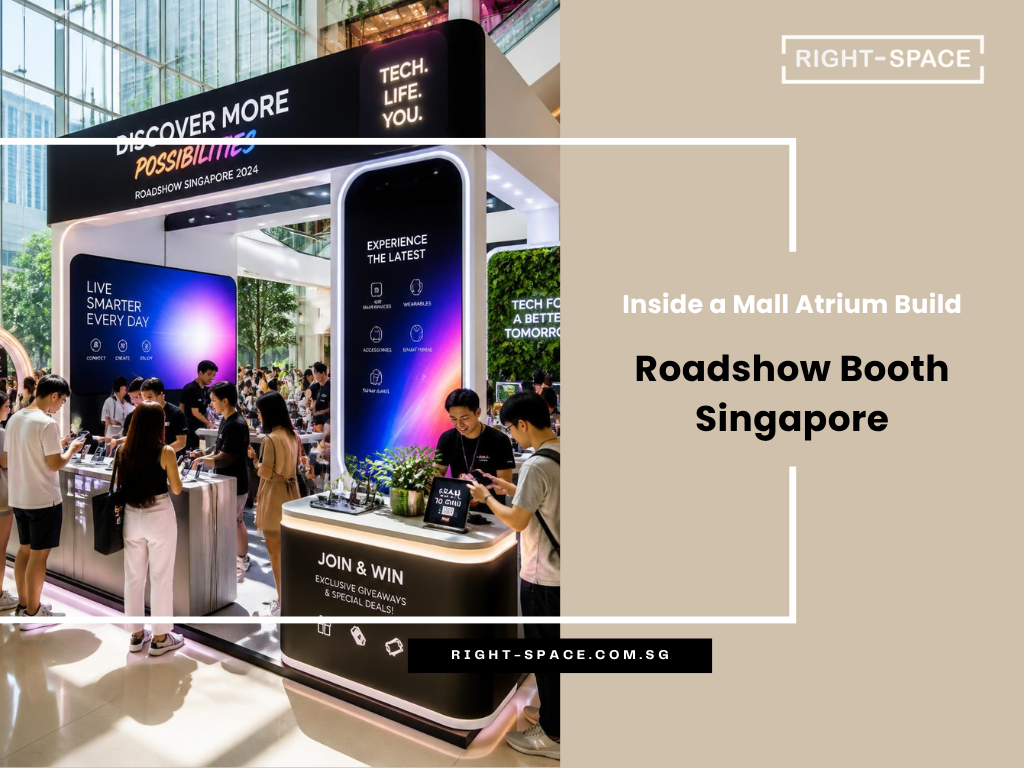
Mall roadshow calendars in Singapore are running fuller in 2026 than they have in five years, and a well-executed roadshow booth Singapore build is now competing for atrium space against product launches, festive installations, and pop-up retail. Brands who book late are stuck with second-choice slots at second-choice malls. This blog walks you through what a mall atrium roadshow booth actually contains, what it costs, and how Right-Space’s events and marketing capabilities approach the build from brief to reinstatement.
What is a roadshow booth and how does it differ from an exhibition booth?
A roadshow booth is a mobile, campaign-length build designed for public consumer footfall, most commonly in mall atriums, MRT concourses, and community hubs. An exhibition booth, by contrast, lives inside a ticketed trade venue like Suntec Singapore, Sands Expo, or Singapore EXPO and is engineered around trade-visitor behaviour.
The design brief differs at almost every layer. Roadshow booths prioritise open sightlines from three or four sides because shoppers approach from every direction, whereas exhibition booths often work with defined aisle traffic. Roadshow builds carry a lower per-square-metre finish investment because they cycle across multiple malls in one campaign, while exhibition booths often live at one venue for one show. Roadshow booths also need to fit inside overnight install windows measured in hours, not days.
In practice, the same brand runs both formats through the year: an exhibition booth at ITB Asia in October, and roadshow booths across CapitaLand and Frasers Property malls through November and December. The engineering economics are different, so the contractors are often different too.
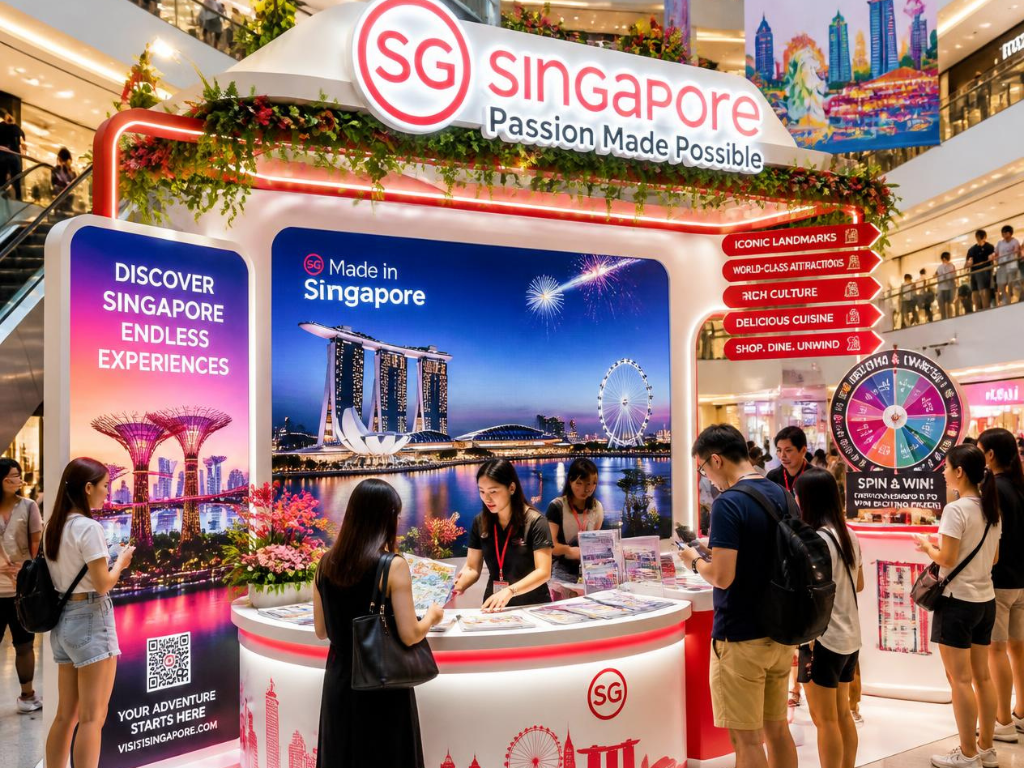
Which Singapore malls accept roadshow bookings and how do you book atrium space?
Roadshow atrium bookings in Singapore are managed by the mall operator’s marcom or leasing team, not by the mall’s day-to-day operations desk. Booking lead times vary by operator size.
CapitaLand runs a centralised events booking portal covering assets including Bugis Junction, ION Orchard, Plaza Singapura, Raffles City, and Tampines Mall. Peak-slot lead times run 3 to 6 months. Frasers Property manages bookings for Causeway Point, Northpoint City, and Waterway Point through its centre management teams, with peak lead times of 2 to 4 months. Lendlease’s Jem and 313@somerset typically require 2 to 3 months. Independent malls including Great World and Wisma Atria are booked directly with each centre’s marcom lead.
Most operators require a booth mock-up (3D visualisation), a completed application form, proof of general liability insurance covering S$1 million minimum, and a security deposit before slots are confirmed. Deposits typically fall between SGD 3,000 and SGD 8,000 depending on booth size and campaign length.
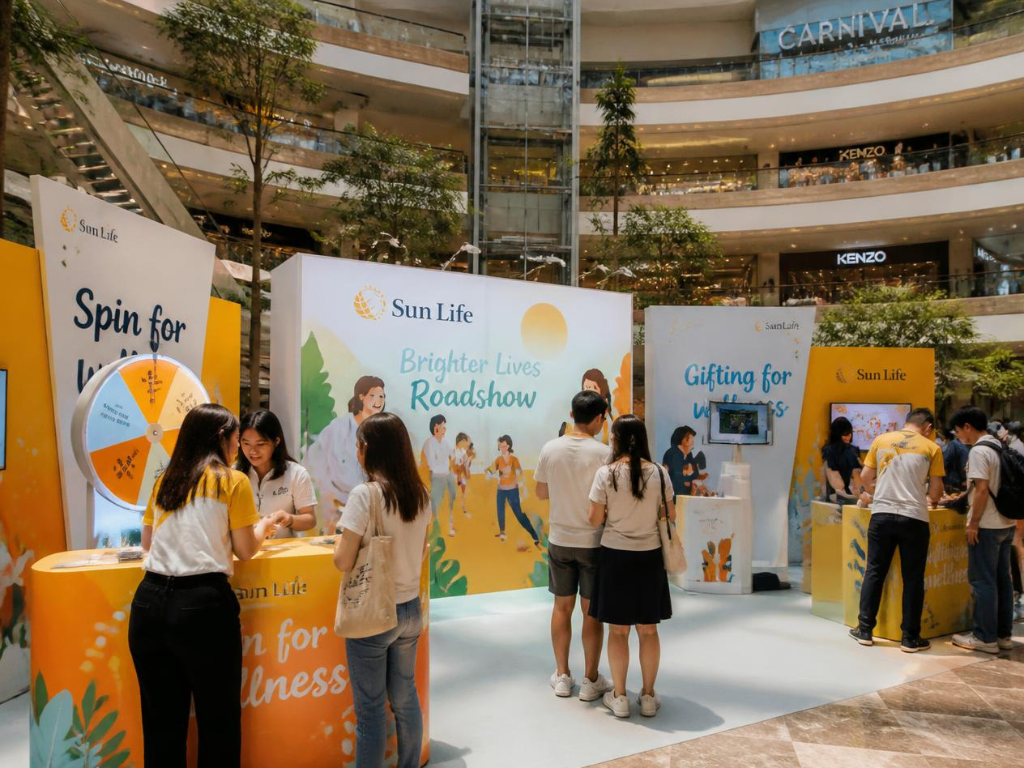
How much does a mall atrium roadshow booth cost in Singapore?
A standard 4m × 4m mall atrium roadshow booth in Singapore for a 3-day campaign runs SGD 8,000 to SGD 15,000 for the build alone. Add SGD 3,000 to SGD 8,000 for atrium space rental. A larger 6m × 6m or 8m × 4m build with premium finishes, LED walls, and integrated sampling zones runs SGD 20,000 to SGD 35,000, with atrium rental of SGD 6,000 to SGD 20,000 depending on the mall’s tier.
The build cost breaks down predictably: aluminium truss system (18–22%), raised platform and flooring (12–15%), SEG fabric graphics (15–20%), lighting and electrical (10–12%), POSM and merchandising fixtures (10–15%), crew including load-in/load-out labour (15–18%), and design plus project management (10–15%). Costs scale linearly with square metreage up to about 30 sqm, then jump for double-deck or elevated feature elements.
The product launch event cost ranges for 2026 covers the adjacent economics of a full-scale brand launch, useful when a roadshow is part of a broader launch programme rather than a standalone activation.
What is the overnight install window and how does load-in work at Singapore malls?
Most Singapore malls give roadshow contractors a 4 to 8 hour overnight install window, running from mall closing at 10pm to 6am the following morning. CapitaLand malls typically allow 6 to 8 hours. Frasers Property operates tighter windows at 4 to 6 hours. Wisma Atria and select Orchard Road malls compress this to 3 to 4 hours because of adjacent tenant operations.
The load-in sequence is fixed by the operator. Contractors arrive at the mall loading bay, present pre-approved crew passes, and use goods lifts to move truss, panels, platform sections, and printed graphics up to the atrium. A 4m × 4m booth typically needs a crew of 4 to 6 for a 6-hour install, including one licensed electrician for power termination. Larger 8m × 8m builds need 8 to 10 crew.
Load-out mirrors the load-in in reverse, usually the night the campaign closes. Reinstatement of the atrium floor and surrounding tenant areas is checked by the mall’s night-shift operations team before crew are released. If damage is found, the security deposit is drawn against. How a Singapore event production company runs coordination covers the operational discipline behind these overnight windows in more depth.
What are the floor loading limits and reinstatement rules to design around?
Mall atrium floor loading limits in Singapore typically range from 5.0 kN/sqm on ground-floor atriums to 3.0–4.0 kN/sqm on upper-level atriums. Structural limits are set by the Building and Construction Authority and enforced by mall operators through pre-approval of booth drawings.
The practical implication: a raised platform with concrete-filled base weights can breach loading limits at upper-level atriums. Roadshow contractors design around this by using timber-only platform systems, distributed base plates, and aluminium truss instead of steel. A booth that passes at Raffles City’s ground floor atrium may need re-engineering to install at Jem’s Level 2 atrium.
Reinstatement conditions are equally strict. Malls require the atrium to be returned to pre-install condition, which means no adhesive residue on floors, no scratches to marble or granite finishes, no drilled holes into permanent structures, and no ceiling attachments without prior approval. Contractors typically lay protective floor sheeting during install and remove it at the end of load-out.
What actually goes into a mall atrium roadshow build?
A complete mall atrium roadshow build typically integrates seven components: an aluminium truss system as the structural spine, a raised platform to define the campaign zone, SEG fabric graphics on the outward-facing walls, integrated LED lighting on the truss, POSM (point-of-sale materials) including product displays and pricing panels, one or more sampling counters or demonstration desks, and a lead capture station.
The truss system is usually a bolt-together aluminium extrusion measuring 290mm × 290mm cross-section, rated to carry the SEG fabric and overhead lighting without ceiling attachment. This matters because most mall atriums do not permit rigging to the mall’s own ceiling structure. The raised platform is typically 100mm to 150mm high on a timber frame, sized to elevate the brand experience above the shopper’s eye baseline.
SEG (silicone edge graphics) fabric replaces printed vinyl because it is reusable across multiple mall stops in the same campaign, easier to transport, and has no visible seams when tensioned properly. A single SEG panel for a 3m × 2m wall costs SGD 250 to SGD 450 depending on print substrate.
POSM and the sampling counter carry the commercial workload. A sampling counter that produces 45 to 90 seconds of shopper dwell time will out-perform a passive hoarding that shoppers walk past in 15 to 20 seconds. That dwell delta is the single largest predictor of sales conversion at mall roadshows. Brands wanting to see how roadshow design that captures attention in Singapore malls actually plays out can review Right-Space’s detailed field notes on this.
How long should a Singapore mall roadshow run?
Most Singapore mall roadshows run 3 to 7 days at a single mall, with the total campaign extending across 3 to 6 mall stops over 4 to 12 weeks. A single-day roadshow rarely justifies the fixed cost of build, atrium rental, and crew mobilisation.
Weekend-heavy scheduling drives most of the campaign ROI. Saturday and Sunday footfall at malls including Jem, VivoCity, and Nex is typically 2 to 3 times weekday levels. Campaigns booked to include two full weekends and a Christmas or National Day long-weekend period produce meaningfully higher sales-per-day than mid-week-only campaigns.
Roadshows that stretch beyond 14 days at a single mall tend to lose visual freshness, and shopper repeat exposure without campaign refresh reduces engagement. Contractors handling multi-stop campaigns amortise the build cost across venues, which is why a 5-mall run is often cheaper per day than a single 5-day stay at one mall. Planning discipline mirrors what product launch event planning timeline in Singapore documents for adjacent launch programmes.
How do you design a roadshow booth to maximise footfall and dwell time?
The three design decisions that most affect footfall and dwell time are booth orientation to shopper flow, the presence of an active demonstration or sampling zone, and eye-level branding density.
Booth orientation matters because atrium shoppers approach from multiple vectors. A booth with only one “front” loses 60% of its potential impressions. The stronger design orients the primary demonstration zone at 45 degrees to the two dominant footfall lanes, with SEG graphics visible from all four sides. This is standard practice at brands running consistent multi-mall campaigns.
Active demonstration or sampling drives dwell time. A shopper who accepts a sample stays 45 to 90 seconds on average, versus 15 to 20 seconds for a passive walk-past. Research from the Institute of Practitioners in Advertising has documented similar dwell-to-conversion patterns in retail environments across markets.
Eye-level branding density means the primary brand mark and hero product should be visible between 1.5m and 2m above the platform surface, which is the natural line of sight for a walking adult. Booths that put the brand mark too high (above 2.5m) or too low (below 1.2m) lose recognition. Bill Bernbach, the DDB co-founder, put it plainly: “The most powerful element in advertising is the truth.” At a roadshow booth, the truth is the product in the shopper’s hand, at eye level, easy to take.
Conclusion
A mall atrium roadshow build is a coordination exercise more than a design exercise. The best roadshows in Singapore are the ones where the truss, the platform, the graphics, the sampling counter, the crew schedule, and the mall’s reinstatement rules all resolve inside a 6-hour overnight window without drama. That takes an operator who has done it enough times to know where the friction lives.
If your brand is scoping a mall atrium roadshow for the Q1 or Q2 2026 calendar, speak to the Right-Space team to lock atrium bookings, PE-endorsed drawings, and crew mobilisation before peak mall slots close.
FAQs About Roadshow Booth Singapore
What permits and safety approvals do I need for a mall atrium roadshow in Singapore?
Mall roadshows do not usually require a standalone SCDF permit because they operate inside pre-approved building premises. However, structures with LED walls, elevated features above 2.4m, or any suspended elements require booth drawings pre-approved by mall operations, referencing SCDF fire safety and BCA structural standards. Contractors must supply general liability insurance and licensed electrical workers.
Should I use a full-service roadshow booth contractor or split design and build?
For mall atrium roadshows in Singapore, a full-service contractor is almost always more reliable than splitting design and build. Coordination during 4 to 8 hour overnight install windows leaves no time for handoff errors between separate parties. Full-service operators like Right-Space handle design, PE endorsement (where required), fabrication, install, and reinstatement under one contract.
What lead time do I need before a Singapore mall roadshow?
Book atrium slots 3 to 6 months ahead for CapitaLand assets and 2 to 4 months for Frasers Property, with tighter turnaround possible at independent malls. Design, PE endorsement, and fabrication then need 4 to 8 weeks. A brand committing 6 months out has the widest slot choice and lowest peak-season premium. Late bookings (under 4 weeks) usually mean shell-scheme rentals rather than custom builds.
Can I run a roadshow booth outdoors in Singapore instead of inside a mall?
Yes, but outdoor roadshows in Singapore require additional permits from the relevant town council or URA, weather-resistant structural design, and typically higher build costs due to wind loading and rain-resistant electricals. Popular outdoor sites include Bugis Junction’s outdoor plaza and community club forecourts. Indoor mall atriums remain the default because they eliminate weather risk and deliver more predictable footfall.
How is a roadshow booth different from a pop-up store?
A roadshow booth is a short-duration (3 to 14 day) build focused on brand engagement, sampling, and lead capture. A pop-up store is a 1 to 6 month temporary retail lease inside a mall’s demised shop space with full POS, staffing, and inventory. Roadshow booths occupy atrium common space and rarely process retail transactions at scale; pop-up stores operate as fully licensed retail units.
Related Insights
Browse our latest articles on event management, exhibition design, and brand activation in Singapore.
View All Insights