

Office Renovation Cost Singapore 2026: Line-by-Line Budget
21 October 2026
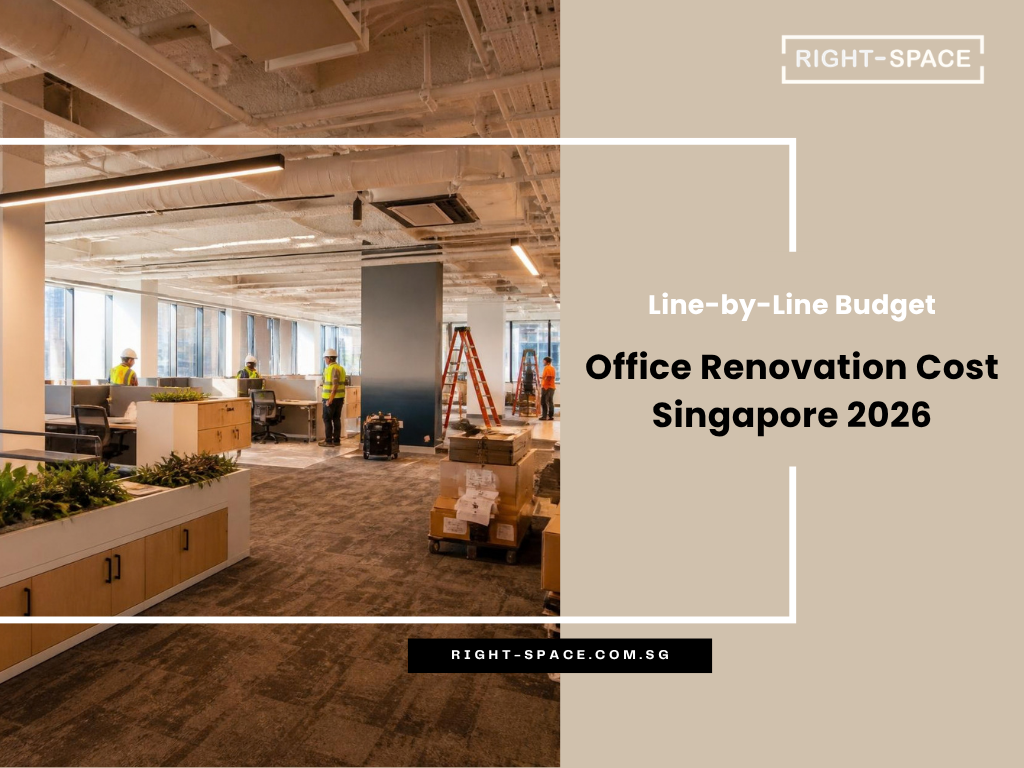
An office renovation in Singapore costs the construction and M&E works plus fees, approvals, furniture, 9% GST, contingency, the rent you pay while the space is unusable and the reinstatement bill at the end of the lease. Published per-square-foot rates range from S30toS450, so this guide shows founders and finance leads how to build a line-by-line budget instead.
An office renovation cost in Singapore is the full amount a tenant pays to turn leased space into a working office: construction and M&E works, design fees, authority and landlord charges, furniture and IT, 9% GST, contingency, and the rent paid while the space cannot be used. BCA estimates building tender prices rose about 1% in 2025. Right-Space’s commercial interior design and build team prices offices line by line.
How much does an office renovation cost in Singapore?
Right-Space’s published starting point for commercial interior projects is around S$50,000, with standard projects taking 6 to 12 weeks; the final figure depends on floor area, M&E changes and the number of enclosed rooms. Per-square-foot rates help as a sanity check and fail as a budget.
The market’s own numbers show why. On 5 October 2026, nine contractor pages ranking for this search published office renovation rates from S30psfatthelowendtoS450 psf at the high end. That is a fifteenfold range for the same question, and none of the pages state what their rates include.
The spread comes from scope. A paint-and-carpet refresh of an open floor and a new office with glass meeting rooms, relocated air-conditioning and custom joinery are both “office renovations”. They share a search term and little else.
The cleaner approach is to price the job in lines, then divide by floor area at the end if the board wants a psf figure.
Office renovation cost breakdown: the line items
An office renovation budget has six layers: construction, M&E, fees and approvals, furniture and technology, tax, and time. Every quote should show each layer separately, so you can see what is included and compare like with like.
|
Line item |
What drives the cost |
Fixed by rule or set by scope |
|
Demolition, hacking and disposal |
Condition of the handed-over space |
Scope |
|
Partitions, doors and glazing |
Number of enclosed rooms, glass versus drywall |
Scope |
|
Ceilings, lighting and flooring |
Ceiling height, lighting design, finish grade |
Scope |
|
M&E: power, data, air-conditioning, sprinklers, fire alarm |
How far the layout departs from the existing services |
Scope |
|
Joinery and branding |
Reception, pantry, storage, feature walls |
Scope |
|
Design, project management, Qualified Person, licensed electrician |
Delivery model and authority triggers |
Scope, partly regulated |
|
Authority fees, landlord deposit and insurance |
SCDF schedule, lease terms |
Fixed by rule |
|
Furniture, AV and IT |
Headcount, meeting room technology |
Scope |
|
GST at 9% |
Contract value |
Fixed by rule |
|
Contingency |
Unknowns in an existing building |
Your decision |
|
Rent during works and reinstatement at exit |
Lease terms, programme length |
Lease |
M&E deserves the closest look. BCA’s Building Works Tender Price Index, the official measure of building tender prices, excludes mechanical and electrical works because they are too project-specific to index. In practice, M&E changes are where most office quotes diverge.
Fixed costs set by rules: fees, deposits, insurance and GST
Some office renovation costs are set by regulators and landlords rather than by the contractor, and they belong in the budget before any design starts. These are the lines you can predict exactly.
SCDF charges plan fees when works count as fire safety works. Its plan approval schedule sets S90perstoreyforadditionsandalterationstoexistingfiresafetyworksthataddnofloorarea.NewfiresafetyworkscostS100 per 100 m² without prescribed measures, and S160per100m²wheremeasuressuchassprinklersorfirealarmsareinvolved.MinoralterationsusealodgementatS90 per submission. The Fire Safety Certificate itself carries no SCDF fee.
Landlords set the next layer. CapitaLand’s November 2023 fit-out guidelines for one of its commercial buildings require a fit-out deposit of S1persquarefootofleasedareawithaS5,000 minimum, and contractor public liability insurance of at least S2millionperaccident.A3,000sqftofficethereforepaystheS5,000 minimum, refundable after the joint inspection.
GST applies at 9% to standard-rated supplies made on or after 1 January 2024, according to IRAS. On a S100,000contractthatisS9,000. GST-registered businesses can claim it back as input tax under IRAS’s recovery rules; non-registered businesses carry it as a cost.

Rent during the works is part of the renovation cost
Every week the office cannot be used costs rent, so programme length is a cost line even though no contractor quotes it. At CBRE’s Q2 2026 Core CBD Grade A average of S12.50persquarefootpermonth,a3,000sqftofficecostsS37,500 a month, or about S$8,654 a week.
That figure changes how delays look. A two-week wait for landlord or SCDF approval costs about S17,300inrentonthatfloor.ThesameweekcostsaboutS2,885 on a 1,000 sq ft office and about S$14,423 on 5,000 sq ft at the same rate. Outside the core CBD, rents are lower and the same arithmetic applies at the local rate. These are our calculations from the published rate.
The government frames construction efficiency in the same terms. Minister for National Development Chee Hong Tat said in February 2026 that his aim is to “save costs, save time, save manpower” across the built environment sector.
Two moves cut this cost. Negotiate a rent-free fit-out period in the letter of offer, and freeze the design before submissions go in.
What pushes office renovation prices up
Office renovation prices rise with enclosed rooms, M&E changes, after-hours working, custom joinery and design changes after the drawings are frozen. Each adds labour, materials or rework that a floor-area rate does not capture.
Enclosed rooms cost more than open floor because each needs walls, a door, its own lighting and often its own air-conditioning and sprinkler adjustments. Moving air-conditioning or sprinklers triggers M&E design, testing and sometimes SCDF submission. After-hours works add cost in buildings that restrict noisy work; CapitaLand’s guidelines charge out-of-hours attendance and standby fees to the tenant. Acoustic, lighting and sustainability upgrades, the trends driving office upgrades, add materials as well.
Changes after the design freeze cost the most. Our guide to why variation orders happen covers how scope gaps turn into extra bills.
The market adds pressure from outside. BCA expects tender prices to stay steady in 2026 after a rise of about 1% in 2025, according to its Singapore Construction Prospects 2026 paper. The same paper forecasts commercial construction demand rising from S2.2billionin2025toS6.1 to 6.7 billion in 2026, driven by the Marina Bay Sands expansion and redevelopments at Tanglin Shopping Centre and HarbourFront Centre. Book trades early.
Design fee or design and build: how the fees are structured
Design and build folds design, project management and construction into one contract sum, while appointing a separate designer means paying a design fee and then tendering the build. Both work; the choice changes how fees appear and who carries the risk of gaps between drawings and site.
Design and build suits fixed move-in dates and teams without an in-house project manager, because one party owns the programme and the defects. Right-Space runs this model in five stages: consultation, concept development, final design with 3D visualisation and material selection, build and supervision, and handover with a final walkthrough and defect check.
A separate designer suits companies that want to compete the build on price and have time for two appointments. Expect to pay for the designer’s time on site as well, because someone has to check that the contractor builds what was drawn.
Worth noting: ask any design-and-build contractor to show the design and professional fee as its own line. That figure matters for tax, as the next section explains.
Is an office renovation tax deductible? Section 14N
Qualifying office renovation spending can be deducted under Section 14N of the Income Tax Act 1947, up to S$300,000 of qualifying expenditure for every relevant three-year period. The works must not affect the structure of the premises.
According to IRAS guidance on business expenses, qualifying items include general electrical installation and lighting, doors and windows, and fixed partitions. From YA 2025, designer and professional fees also qualify, provided they do not relate to structural works that need approval from the Commissioner of Building Control. The deduction is spread over three Years of Assessment, with an option to claim in one.
This changes the after-tax cost of the same contract. An itemised quote that separates qualifying works and fees from furniture and structural items makes the claim easier to support. This is general information, not tax advice; confirm your position with your tax adviser.
Contingency and reinstatement: the start and the end of the budget
Hold a contingency for unknowns in the existing space, and price reinstatement before you sign the lease, because both are real costs that most first budgets leave out.
Existing offices hide things. Old cabling above the ceiling, sprinkler heads that clash with new rooms and landlord comments on the first submission all cost money after the quote is signed. Hold at least 10% of the construction sum as contingency, and more where the previous tenant’s ceiling and services stay in place. Release it only against documented changes.
Reinstatement sits at the other end of the lease. The lease decides whether the office goes back to bare shell, and that bill arrives when the business is moving and least able to absorb it. Right-Space advises on reinstatement requirements against the landlord agreement; ask for an estimate at the start so the full-lease cost is visible.
How to compare office renovation quotes
Compare office renovation quotes only when they are priced from the same drawings, itemised line by line, and clear about what is excluded. A lower total that leaves out M&E, authority fees or after-hours work prices a different job.
Before comparing totals, confirm each quote states the drawing revision priced, an itemised bill of quantities, the exclusions (furniture, AV, authority fees, GST, after-hours premiums), the payment schedule and the defects period. Ask how variations are priced, and who submits to SCDF and the landlord. Where two quotes differ by more than the contingency you plan to hold, check the exclusions first; that is where most gaps sit, and it is cheaper to find them before negotiating on price.
Right-Space’s projects close with a final walkthrough and defect check, followed by short-term rectification support, with extended maintenance arranged separately.
Budget the whole office before the build
The real cost of an office renovation in Singapore is the build plus everything around it. Fixed fees and deposits, 9% GST, contingency, rent during the works and the reinstatement bill at exit all count, offset in part by the Section 14N deduction. A per-square-foot rate hides most of it. Budget line by line, freeze the design before submissions, negotiate the fit-out period and price reinstatement on day one, and the approved figure stays close to the final account.
Planning an office move or refit? Request an itemised estimate through a free consultation with Right-Space’s design team.
Frequently asked questions
Do I pay GST on an office renovation in Singapore?
Yes. GST applies at 9% to standard-rated supplies made on or after 1 January 2024, according to IRAS, so a S100,000renovationcarriesS9,000 in GST. GST-registered businesses can claim it as input tax, subject to IRAS’s recovery rules; businesses that are not registered carry it as a cost.
Is the fit-out deposit for an office refundable?
Yes, once the landlord’s conditions are met. CapitaLand’s November 2023 guidelines, for example, set the deposit at S1persquarefootofleasedareawithaS5,000 minimum and refund it without interest after the joint inspection, rectifications and submission of as-built plans.
How much contingency should I set for an office renovation?
Hold at least 10% of the construction sum, and more when the previous tenant’s ceiling and M&E remain in place. Hidden cabling, sprinkler clashes and landlord comments on the first submission are the usual draws. BCA’s Tender Price Index excludes M&E, so M&E risk deserves its own allowance.
Can I claim tax deductions for office renovation in Singapore?
Yes, for qualifying works. Section 14N of the Income Tax Act 1947 allows deductions on up to S$300,000 of qualifying renovation spending per three-year period, including designer and professional fees from YA 2025 where they are not linked to structural works. Confirm your position with a tax adviser.
Who pays for office reinstatement at the end of a lease?
The tenant, where the lease requires it. The reinstatement clause in the lease sets whether the office returns to bare shell or is handed back as built, so read it before signing and ask your contractor to estimate the exit cost alongside the fit-out. On a three-year lease signed in 2026, that bill falls due in 2029.
Related Insights
Browse our latest articles on event management, exhibition design, and brand activation in Singapore.
View All Insights