

Commercial Christmas Decoration Singapore: A Guide
15 July 2026
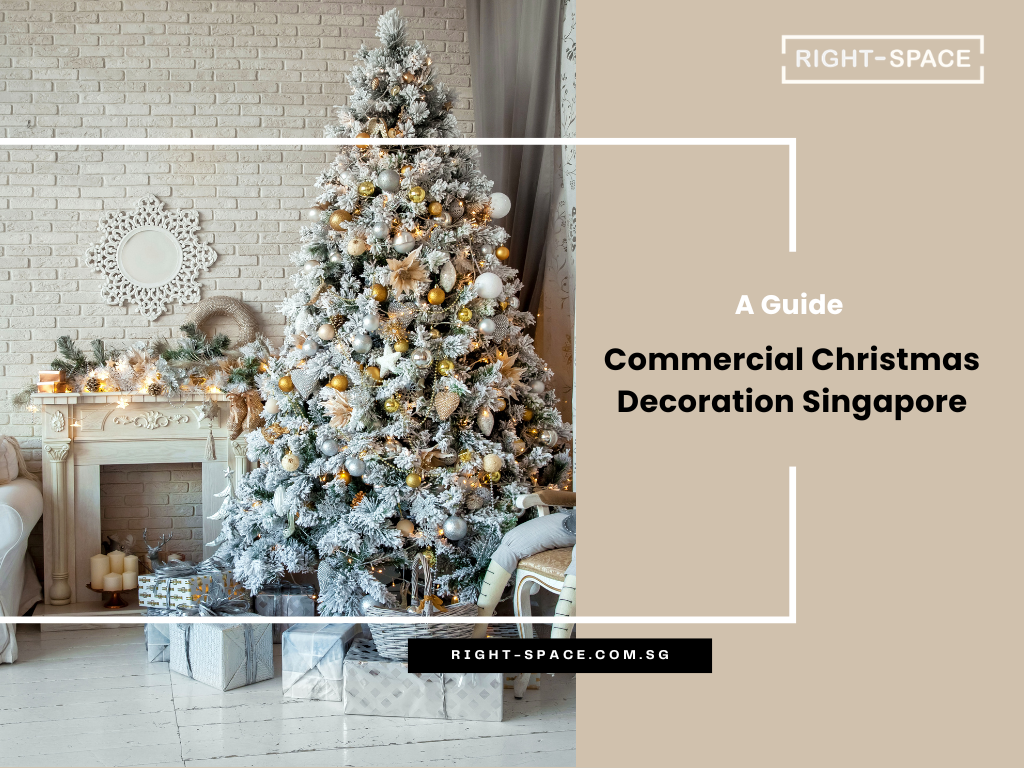
Commercial Christmas decoration in Singapore is a competitive retail investment, not a seasonal afterthought, and the strongest schemes are planned by mid-year. Malls and retailers compete on festive identity because a distinctive display measurably lifts footfall during the highest-spending weeks of the year. This blog walks you through what malls, retailers, and hotels should know before they commission. It draws on Right-Space’s work in commercial interior design in Singapore.
What is commercial Christmas decoration, and who is it for?
Commercial Christmas decoration is the design, fabrication, and installation of festive schemes for retail and public spaces, built to public-safety standards and aimed at driving footfall. It serves shopping malls, retail chains, hotels, and commercial landlords, not households. The output is a themed environment spanning atriums, storefronts, and lobbies, tied to one concept and a brand’s commercial goals.
The distinction from home decoration is structural and legal. A commercial scheme is engineered, fire-compliant, and installed in a trading venue under strict access rules, where a home setup answers only to taste. It is closest in discipline to seasonal commercial design: the same concern for brand alignment, traffic flow, and compliance that governs a permanent fit-out applies to a six-week festive build. Treat a Christmas scheme as a retail asset, because a mall atrium display is a footfall instrument measured on results, not a decoration admired in passing.

How does mall Christmas decoration differ from retail storefront decoration?
Mall Christmas decoration works at architectural scale while storefront decoration works at brand-signature scale, and the two need different budgets and approvals. A mall atrium scheme is a multi-storey centrepiece, often a giant tree, designed to become a photo destination that pulls visitors through the whole building. A retail storefront scheme is a focused brand statement at the shop front, designed to stop a passing shopper and pull them in.
The scale gap drives everything downstream. A mall centrepiece needs structural engineering, an atrium-height install, and coordination with the landlord’s operations team, while a storefront works within a tenant’s lease line and the mall’s shopfront guidelines. The cleaner approach for a retail chain is a repeatable storefront kit that installs consistently across many outlets, rather than a bespoke build per store. Match the ambition to the venue: an anchor tenant or landlord invests in the atrium centrepiece, while a multi-outlet retailer invests in a consistent, reusable storefront identity.

What does a themed Christmas concept actually involve?
A themed Christmas concept is the single creative idea that unifies colour, motif, materials, and photo moments across the whole scheme, and it is what separates a memorable display from generic tinsel. The concept sets the palette, the ornament style, the lighting mood, and the hero centrepiece, so every element reads as one story rather than a collection of decorations. Singapore’s landmark schemes show the range: Jewel Changi ran a 16-metre Disney Cruise Line tree in the 2025 season, and Marina Bay Sands dressed its spaces with nearly 190 trees under one coordinated theme.
Concept is where bespoke fabrication earns its cost. A distinctive theme executed in a Suntec City festive centrepiece delivers a brand-owned look that an off-the-shelf tree cannot, with custom ornaments, integrated LED installation, and photo-friendly sightlines built in. The concept also has to survive weeks of public traffic without looking tired. Lock the concept before fabrication, because a scheme designed as one idea installs cleanly and photographs consistently, while a decoration-by-committee build reads as clutter under mall lighting.
How is hotel lobby Christmas decoration different again?
Hotel lobby Christmas decoration prioritises atmosphere and brand prestige over mass footfall, so it reads as refined rather than loud. A hotel lobby scheme sets a mood for guests the moment they arrive, using a considered centrepiece, layered lighting, and quality materials that match the property’s positioning. The audience is smaller and higher-value than a mall crowd, which changes the design brief entirely.
The constraints are also different. A lobby is a live, premium, front-of-house space, so installs run overnight or in low-traffic windows, and the finish has to be flawless up close where guests stand within arm’s reach. Materials skew to quality over spectacle, and the centrepiece is sized to the lobby’s proportions rather than to a multi-storey atrium. Design a hotel scheme to the property’s brand tier and sightlines, because a lobby display that overwhelms the space or shows rough finish undercuts the exact premium impression it was meant to create.
What goes into the install during operating hours?
Commercial Christmas installs happen around a live, trading venue, which usually means overnight or after-hours work so the display appears without disrupting business. A mall or hotel cannot close for a build, so crews load in through service routes after hours, assemble against a fixed schedule, and clear public areas before opening. The install window is the binding constraint, and a scheme that ignores it becomes a problem the morning doors open.
This is a logistics discipline the strongest partners already run for permanent fit-outs. Right-Space regularly delivers after-hours and staged works so commercial clients stay operational during a build, which is the same capability a festive install demands. Loading access, lift dimensions, crew scheduling, and pre-assembly all decide whether an overnight install lands on time. Plan the operating-hours install sequence before fabrication, because on-site time in a trading venue is the most expensive and least forgiving time in the entire project.
What safety and flame-retardant rules apply to Christmas displays?
Commercial Christmas displays in Singapore must use flame-retardant materials and meet fire-safety and structural-stability standards, and large or enclosed structures can fall under SCDF oversight. Decorative fabrics and props need recognised fire-retardant certification with documentary evidence, LED installation must be wired to standard, and structures must stand stable through weeks of public contact. Egress routes and walkways have to stay clear, because a display that blocks an escape path fails inspection regardless of how it looks.
This is where festive work meets the compliance discipline of permanent commercial design. The same authority-approval rigour behind how compliance and approvals are handled on a fit-out applies to a festive build, and some temporary structures require formal sign-off through SCDF’s fire safety permit guidance. The cost of getting this wrong is a display ordered down after it is built. Specify flame-retardant materials and a stable structural method at the design stage, because a public Christmas display is inspected as a safety installation, not judged as decoration.
How does sustainability factor into commercial Christmas decor?
Sustainability now shapes commercial Christmas decor because mall operators and corporate clients increasingly require reusable, low-waste schemes rather than single-use builds. Modular structures, durable ornaments, and stored-and-reconfigured centrepieces spread cost across seasons and cut the waste a fresh annual build generates. This mirrors the wider shift in Singapore commercial design, where more than 60% of businesses have integrated eco-friendly materials into their fit-outs, a trend detailed in Right-Space’s overview of sustainable and experience-driven retail trends.
The commercial logic is straightforward. A reusable festive system costs more upfront and less over three seasons, since the structural frame and core elements return to storage while only the theme layer changes. Some venues now score sustainability formally, so a low-waste scheme can be a procurement requirement, not a nice-to-have. Design festive schemes for reuse from the first concept, because a build planned around storage and reconfiguration serves both the budget and the sustainability targets mall operators increasingly hold their tenants to.
Does Christmas decoration measurably increase dwell time and sales?
Yes. Commercial Christmas decoration measurably increases dwell time, footfall, and social-media reach, which is why malls and retailers reinvest in it every year. A distinctive centrepiece becomes a photo destination that pulls visitors in and holds them longer, and the user-generated content it produces extends reach far beyond the physical floor. Longer dwell time correlates directly with higher spend during the peak retail weeks of the year.
Singapore’s retail calendar is built around this effect. Orchard Road structures its entire year-end footfall strategy around the Orchard Road Christmas light-up, and malls compete on festive identity because a stronger display lifts visitor traffic when it matters most. A mall scheme that turns a common area into a reason to visit, like a mall festive install in practice, pays back in footfall rather than sitting as a seasonal cost. Brief a Christmas scheme against the visitor outcome you want, because decoration chosen for looks alone leaves the commercial return on the table.
How far ahead should malls and retailers book?
Malls and retailers should confirm their Christmas concept and build partner by mid-year, because design, fabrication, and install slots for the peak season fill fast. Large festive centrepieces commonly need 25 to 45 days of fabrication depending on scale, before any install, and that sits on top of concept development and approval time. Most Singapore malls light up their displays by mid-November, which fixes the deadline and pulls fabrication into the months before.
The lead time compounds in peak season, when every venue competes for the same workshop capacity. A mall that commissions in September is choosing from whatever fabrication slots remain, while one that commits in June shapes its own scheme on its own timeline. You can see the range of festive and commercial work in more project write-ups and guides from Right-Space. Commit the concept and partner by mid-year, because a Christmas centrepiece commissioned late is either rushed in finish or missing from the atrium when the season opens.
Bespoke build or off-the-shelf: which should a retailer choose?
Choose a bespoke build when brand differentiation and reuse justify it; choose off-the-shelf when speed and low upfront cost matter more than distinctiveness. A bespoke scheme delivers a brand-owned look, custom ornaments, and a centrepiece designed to the exact space, at higher cost and longer lead time. Off-the-shelf trees and decor install fast and cheap but look like everyone else’s, which undercuts the differentiation a festive investment is meant to buy.
The decision turns on reuse and brand stakes. A landlord or anchor tenant running the same atrium every year gains from a bespoke, modular scheme that amortises across seasons and builds a recognisable festive identity. A short-term pop-up or a tight-budget outlet is better served by a quality off-the-shelf setup. The honest rule: if the display is a repeating, brand-defining asset, build bespoke and reuse it; if it is a one-season stopgap, buy off-the-shelf and move on.
Conclusion
Commercial Christmas decoration is seasonal retail design with a fixed deadline. Behind the tree sit a unifying concept, flame-retardant fabrication, an overnight install around a trading venue, and a reuse plan that serves both budget and sustainability targets. Match the scheme to the venue, build to public-safety standards, and treat the centrepiece as a footfall asset rather than a cost. Book by mid-year, because the season opens whether the display is ready or not.
Planning a mall atrium, storefront, or hotel lobby scheme for this Christmas? Ask Right-Space to scope a themed concept, fabrication, and operating-hours install package now, while workshop and install slots for the season are still open.
FAQs About Christmas Decoration Singapore ommercial
How much does commercial Christmas decoration cost in Singapore?
Cost scales with the size of the centrepiece, structural complexity, LED integration, and install conditions, so a storefront scheme sits far below a multi-storey mall atrium build. Right-Space scopes festive projects after the concept and site are confirmed, because fabrication complexity and operating-hours install access, not floor area alone, drive the figure.
When do Singapore malls put up Christmas decorations?
Most Singapore malls light up their Christmas displays by mid-November, with Orchard Road’s light-up typically running from early November to early January. Installs happen in the preceding weeks, usually overnight to avoid disrupting trading, which is why fabrication runs through the months before and build slots are confirmed by mid-year.
Can commercial Christmas decorations be reused each year?
Yes, when built for it. Modular structures and durable ornaments can be stored and reconfigured across seasons, which spreads the cost of a bespoke centrepiece over several years and cuts waste. Right-Space factors teardown and storage into a festive build so reusable elements return to inventory rather than being discarded.
Do retail Christmas displays need flame-retardant materials?
Yes. Christmas displays in Singapore commercial spaces must use flame-retardant materials meeting recognised fire-retardant standards, and large or enclosed structures can fall under SCDF Temporary Change of Use rules. Certified materials and a stable structural method are specified at the design stage, because a public retail display is inspected as a safety installation.
Related Insights
Browse our latest articles on event management, exhibition design, and brand activation in Singapore.
View All Insights