
Custom Event Booth Cost Singapore: Real Budget Guide
20 March 2026
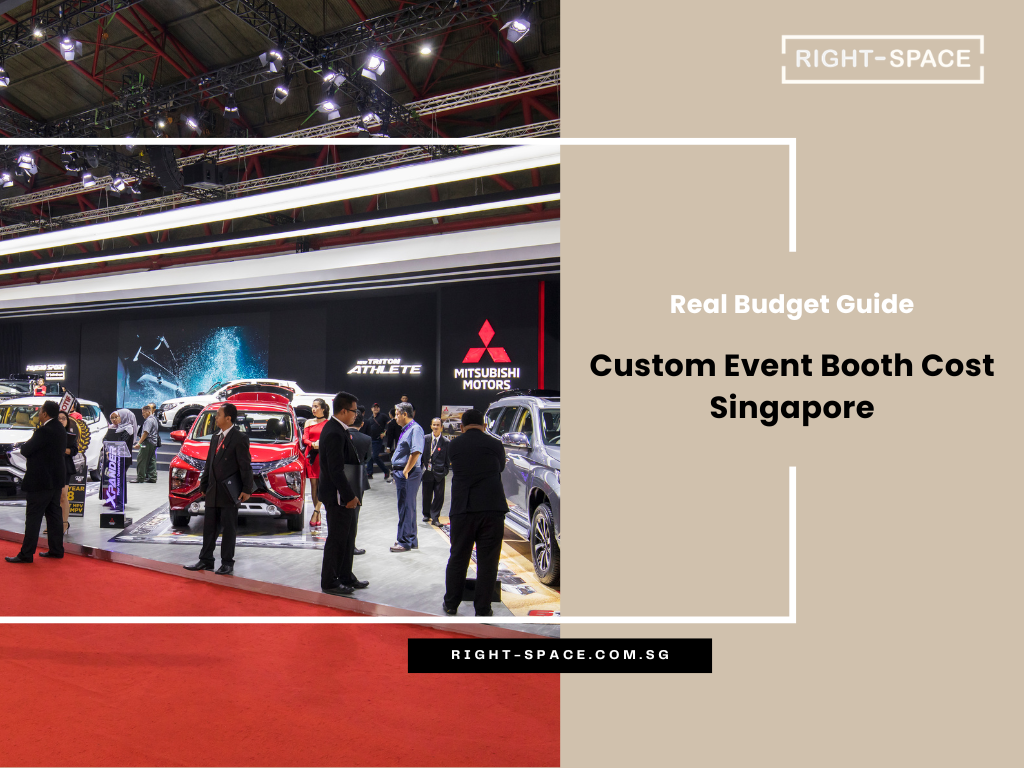
The real custom event booth cost singapore brands should plan for depends on scope, materials, approvals, and installation, not just booth size. This blog will walk you through what actually shapes the budget, where costs usually rise, and how to avoid underquoting your own project from the start.
Brands comparing options usually begin with a service partner that can design, fabricate, install, and coordinate approvals under one workflow, which is why reviewing exhibition booth design services early helps frame budget discussions around execution, not just visuals. Right-Space positions this as an end-to-end process backed by an in-house team and more than 20 years of experience, with custom booth projects typically starting from S$8,000 and above.
What does a custom event booth usually cost in Singapore?
A realistic answer starts with one important distinction. There is no universal rate card for custom booths.
In Singapore, a booth budget changes according to four things: the footprint you booked, the build complexity, the finish quality, and how much technical coordination the show requires. Right-Space states that its exhibition booth projects typically start from S$8,000 and above, while its own cost-focused article also notes that booth setup costs can range from about S$2,000 to S$20,000 depending on booth size and requirements. That wide spread makes sense. A compact booth with standard carpentry and printed graphics is one job. A branded environment with lightboxes, storage, integrated screens, and tight installation windows is another.
For budget planning, most brands are better off thinking in ranges rather than asking for one average number.
A practical planning range
Custom booths in Singapore generally fall into three budget tiers:
Compact branded booth approximately S$8,000 to S$12,000
Typically includes basic custom carpentry, printed graphics, standard lighting, transport, and setup.
Mid-range custom booth approximately S$12,000 to S$25,000
Includes higher-quality finishes, stronger branding elements, storage space, a meeting counter, and upgraded lighting.
Premium custom booth approximately S$25,000 to S$50,000 or more
Includes custom structural features, lightboxes, LED integration, feature walls, and more complex installation requirements.
These ranges are planning guides rather than fixed quotations. They reflect how real projects are priced when design, fabrication, labour, logistics, and venue constraints are considered together.
Why booth size affects price, but not in a simple way
Brands often assume booth cost rises in a straight line with square metres. It does not.
A 3m x 3m booth and a 6m x 3m booth do not differ only because one is bigger. The larger booth usually needs more structure, more wall treatment, more lighting coverage, and more graphics. It may also need clearer zoning for demos, storage, and conversations. That changes both fabrication time and installation time.
Build density matters more than footprint
A small booth can still be expensive if it contains many features.
For example:
- An open layout with one feature wall has lower fabrication requirements
- Multiple partitions and display zones increase carpentry and graphics costs
- Double-sided branding requires additional finishing
- Storage rooms or enclosed discussion areas require more materials and labour
- Tall structures demand additional engineering and installation care
Late changes to layout can destabilise pricing. Once fabrication planning begins, modifications become costly.
This is also why budget conversations should happen together with timeline conversations. If you are still changing layout logic late in the process, your booth size pricing is no longer stable. Right-Space’s timeline article makes that point clearly. Once design lock slips, downstream fabrication and installation become harder to control. Exhibition booth design timeline Singapore explained is a useful reference before finalising scope.
What are you actually paying for?
The cleanest way to understand event booth price singapore is to break the quote into working cost blocks.
1. Design and concept development
This covers spatial planning, 3D visualisation, revisions, material direction, and translation of your brand into a physical experience. On simpler jobs, design is lighter. On larger custom booths, design cost rises because the booth has to solve for visitor flow, product display, messaging hierarchy, and installation practicality.
If a vendor shows beautiful renders but cannot explain fabrication logic, that usually means your quote is light on thinking where it matters. The cost may look attractive upfront, then expand later through variation orders.
2. Booth fabrication cost
This is usually the heaviest budget component.
Booth fabrication cost includes carpentry, structure framing, wall panels, counters, storage units, display fixtures, paint or laminate finish, printed graphics, lightboxes, acrylic, and branded detailing. Materials cost changes sharply depending on finish expectation. A laminated cabinet wall and a painted scenic wall are not priced the same. Neither are standard vinyl graphics and tension fabric lightbox graphics.
Right-Space describes its model as in-house construction and on-site installation, which matters because fabrication ownership affects cost control, revision speed, and finish consistency.
3. Installation cost and dismantling
Installation cost is not a minor add-on in Singapore exhibitions.
Most shows run on fixed move-in windows, often overnight. Labour setup includes loading, assembly, electrical coordination, graphics application, touch-ups, testing, and dismantling after the event. If the build is more complex, the setup crew usually grows. If the venue timing is tight, labour pressure rises with it.
This is where brands often underestimate total spend. A quote that looks cheap on fabrication may become less attractive once transport, site crew, dismantling, and standby time are added.
4. Technical and organiser-related items
These can include electrical layouts, risk documents, submission drawings, venue approvals, rigging coordination, rental screens, and special lighting.
Right-Space notes that it assists with technical drawings, submission documents, risk assessments, and coordination with venue authorities such as Singapore EXPO and Marina Bay Sands. That is a real cost centre in practice, especially for custom raw-space booths.
Why materials cost changes your quote faster than you expect
Material selection has a major impact on cost.
Typical examples include:
- Basic printed boards lower cost, suitable for short-term displays
- Laminated carpentry panels moderate cost, common for corporate walls and counters
- Acrylic logos and lightbox treatments higher cost for premium branding
- Metal framing and custom joinery higher cost but more durable and reusable
Two booths that appear similar in renderings can differ greatly in production cost depending on material specifications.
Strategic budgeting often involves investing in a few high-impact elements, such as a well-lit feature wall rather than premium finishes throughout.
Brands that want a cleaner budget without looking generic often study affordable exhibition booth design strategies or plan for selected premium touchpoints rather than premium finishes everywhere. A well-lit hero wall, one strong demo counter, and disciplined graphics can outperform an overbuilt booth that burns budget on details no visitor notices.
Does custom always cost more than modular?
Usually yes at first, but not always over time.
Custom booths cost more because they are built around a specific brand layout, display need, and visual identity. Modular systems save money when the structure can be reused across multiple shows with minimal changes.
That decision should be tied to your event calendar.
If you exhibit once for a flagship show, a custom build may be the right call. If you exhibit three to five times a year, a modular base with custom graphic skins and selective upgrades can be more efficient.
Right-Space’s published content on booth ideas highlights modular and reusable structures as a continuing design direction, which matches how more brands now balance sustainability, storage, and recurring event spend. Exhibition booth design ideas that attract in 2025 is relevant here because it shows why reusability is not only a budget choice but also a layout and brand decision.
What hidden costs usually catch brands off guard?
The expensive parts are rarely hidden on purpose. They are usually left out during early conversations because the scope is still vague.
The most common late-stage additions are:
- design revisions after approval windows have started
- upgraded finishes after initial costing
- Added storage or enclosed meeting areas
- Screen rentals and electrical changes
- Overtime labour or compressed installation windows
- Rework caused by incomplete artwork or late content approval
Right-Space’s timeline article explains why design lock is such a critical milestone. Once fabrication starts, changes stop being creative choices and become commercial ones. Missing submission windows can also trigger forced simplifications or extra handling.
How venue reality affects budget in Singapore
Singapore’s exhibition environment is structured, venue-led, and deadline-sensitive. That pushes cost decisions upstream.
The Singapore Tourism Board positions the country as a major MICE destination with world-class infrastructure and diverse venues, which is one reason organisers and venues operate on disciplined planning frameworks. Singapore EXPO alone promotes 123,000 sqm of indoor and outdoor event space that can be configured for large exhibitions and shows. In practical terms, that scale means exhibitors are working inside organised submission systems, contractor coordination windows, and fixed operational rules, not informal setups. Singapore’s MICE industry page and Singapore EXPO venue spaces show the level of infrastructure brands are entering when they plan an exhibition build here.
That matters for budget because compliance has labour. Coordination has labour. Precision has labour.
How to budget properly before asking for a quote
A better booth brief produces a better budget faster.
Before requesting pricing, lock these five points:
- Booth size and venue
- Business goal for the booth
- Product display and storage needs
- Required screens, demos, or interactivity
- Reuse intention after the event
When those are clear, a builder can separate must-haves from visual extras. Without that, every quote is a moving target.
Brands that want a stronger commercial filter should also review whether they need a design-led partner or an execution-led contractor. Exhibition booth contractor Singapore vs designer explained is useful because execution ownership directly affects budget stability once fabrication and installation begin.
What budget level is sensible for your brand?
A booth budget should reflect the value of the event, not just the size of the booth.
If the exhibition is tied to lead generation, distributor recruitment, investor visibility, or a major market entry, underbudgeting the environment usually shows. Visitors may not know your build cost, but they notice finish quality, clarity, traffic flow, and whether the booth feels credible.
Right-Space’s service positioning makes sense in this context. The company is not framed as a printer of walls. It is presented as a Singapore-based creative event agency with in-house design, project management, craftsmen, fabrication, installation, and support across exhibition environments. That kind of setup is relevant when brands want budget accountability alongside design quality.
Conclusion
Custom booth budgets in Singapore are shaped by build density, materials, technical requirements, installation pressure, and how early the project is locked. The cheapest number at briefing stage is rarely the most accurate number by show week.
If your team is preparing for a trade show and wants a quote grounded in real production scope, not guesswork, speak to Right-Space with your booth size, venue, objectives, and required features already defined.
FAQs About Custom Event Booth Cost Singapore
How much does a custom event booth cost in Singapore?
For true custom builds, planning often starts from around S$8,000 and rises with booth size, materials, lighting, storage, and installation requirements. Right-Space publishes S$8,000 and above as its typical starting point for exhibition booths.
Why is event booth price Singapore quotes so different between vendors?
The biggest differences usually come from fabrication ownership, material quality, installation scope, and whether technical submissions are included. A builder like Right-Space that handles design, fabrication, and setup under one workflow may quote more completely upfront.
Does booth size pricing work by square metre only?
No. Size matters, but layout density matters too. A small booth with storage, screens, premium finishes, and complex carpentry can cost more per square metre than a larger booth with simpler structure and graphics. This is why design lock affects budget accuracy.
What is included in installation cost?
Installation cost usually covers transport, unloading, assembly, graphics application, lighting setup, touch-ups, testing, and dismantling. At venues such as Singapore EXPO, timing and coordination windows also shape labour setup requirements.
Is a modular booth cheaper than a custom booth?
Usually yes for repeated use. Modular systems reduce rebuild cost across multiple shows, while custom booths suit brands that need a more specific layout, stronger brand presence, or a one-off flagship presentation. Right-Space’s own content highlights modular and reusable structures as a practical direction.