
Custom Event Setup Singapore: What Makes It Buildable
28 February 2026
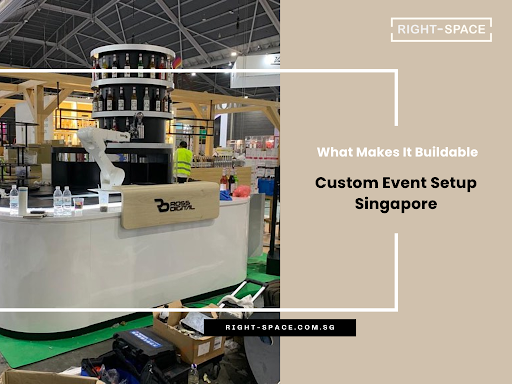
Custom event setup Singapore projects succeed when the design survives real site constraints: access routes, stability, venue rules, and limited install time. This blog will walk you through what determines whether an approved event concept can actually be fabricated, transported, and built on site in Singapore, plus what to check before you commit budget.
For service context, see Right-Space’s Live Events Design & Production.
What “custom event setup” means when you are dealing with real venues
Custom event setup is the on-site assembly of a temporary environment built for a specific campaign or programme. It includes structures, counters, feature walls, staging, lighting, branded surfaces, and the operational “back-of-house” needed to run the experience.
In Singapore, the phrase also implies you can build inside controlled operating conditions. Malls, hotels, convention halls, and office lobbies all run on strict access windows, safety rules, loading bay procedures, and contractor registration. If your design ignores those realities, the setup will either be delayed, downgraded, or rebuilt on the fly.
The hidden reason designs fail: the gap between approval and buildability
Most brand teams approve mood, proportions, and visual direction. Build teams need measurable instructions: exact dimensions, connection methods, weight distribution, cable routing, and installation sequencing.
When those are missing, the build becomes interpretation-driven. Interpretation causes:
- inconsistent finishing and misalignment
- additional fabrication work during install week
- overtime labour and rushed touch-ups
- last-minute compromises that dilute the concept
If you are paying for custom work, buildability is not a “production detail.” It is the foundation that protects your outcome.
The build constraints that decide if your design can be installed on-site
Venue limitations you cannot “solve later”
A buildable event setup starts with venue limitations as fixed inputs.
Key constraints that influence design decisions:
- loading bay slot timing and rules
- distance from loading bay to event space
- service corridor width and turning radius
- lift dimensions and payload limits
- permitted working hours and noise windows
- prohibited anchoring methods such as drilling into flooring or walls
A common failure pattern is designing a one-piece feature wall that looks premium, then discovering it cannot pass through the service corridor or fit in the lift. The fix becomes modularisation late in the project, which changes joinery, seam placement, and finishing, often with visible compromises.
Structural stability and what you are allowed to anchor
Temporary installations still need stability under real crowd movement and operational use. In many venues, you cannot anchor into the floor or walls. That pushes stability decisions back into design and fabrication.
Buildable structures typically solve stability with:
- base weighting sized to the centre of gravity
- bracing that does not intrude into guest flow
- modular frames that lock consistently with repeatable hardware
- rigging only when venue rules and load points allow it
If your design depends on “hidden anchoring” without a confirmed method statement, it is not ready to build.
Temporary installation compliance and fire safety conditions
Some temporary events in Singapore can require approval under SCDF’s Temporary Change of Use framework, depending on context and use case. SCDF’s guidance outlines when a Temporary Change of Use Permit may be required for temporary events such as exhibitions and promotional activities. Refer to the official guidance on SCDF Temporary Change of Use.
This matters because late compliance feedback can force layout changes, access revisions, or removal of enclosed elements after fabrication has started. That is not a paperwork problem. It is a redesign problem with real cost.
Engineering considerations for larger temporary structures
Some setups cross into temporary structures that may need a higher level of engineering oversight depending on design and usage. BCA’s guidance for temporary buildings highlights the Permit to Erect Temporary Building process and the involvement of a Professional Engineer in applicable scenarios. See BCA permit to erect temporary building.
Even when the build does not require that pathway, the engineering thinking still matters: weight distribution, stability, and safe assembly method must be defined, not assumed.
Work-at-height requirements affect time, manpower, and sequencing
Many custom setups involve work at height: truss, lighting focus, overhead signage, ceiling-hung elements, ladder work, and elevated installation.
WSH Council resources outline what work at height is and why controls matter. See WSH Council guidance on work at height.
This affects buildability because it changes:
- the real installation duration
- manpower and equipment needed
- how much can be completed in limited venue windows
- the sequence of tasks that must be done before finishing
If the design requires elevated work but the schedule assumes “standard install time,” you will lose finishing quality.
The concept-to-build translation that turns design into installable instructions
What must exist before event fabrication starts
Event fabrication Singapore is not “making things.” It is producing components that install reliably under time pressure and venue constraints.
Before fabrication starts, a buildable setup should have:
- dimensioned drawings that reflect actual site measurements
- a materials and finish schedule tied to durability needs
- print specifications including lamination and mounting method
- power planning and cable routes
- a modular breakdown that matches access constraints
- an installation sequence plan that fits the venue window
If any of these are missing, the project will rely on improvisation. Improvisation is what makes an event feel like it was “put together,” not built.
Modular structures are not a cost-saving move, they are an access strategy
Brands often hear “modular” and think “cheaper.” In Singapore, modular planning is usually about feasibility.
A modular structure is defined by:
- panel sizes that fit corridors and lifts
- connection methods that align consistently across repeated assembly
- hardware that can be installed quickly without specialist tools
- pre-assembly testing so fit issues are solved off-site
Modularity also protects show-day resilience. If a panel gets damaged, a modular system allows replacement without dismantling the entire build.
Materials and finishes decide whether your setup stays premium after handling
Workshop lighting and careful handling create an illusion. Show-site conditions break illusions fast.
Materials and finishes need to match use:
- high-gloss surfaces show fingerprints and scratches quickly
- delicate laminates can bubble if applied in humid conditions or rushed
- thin panels warp more easily during storage and transport
- certain paints chip during load-in unless protected correctly
A buildable finish specification includes how the surface behaves under handling, cleaning, and lighting. That is what separates a premium setup from a setup that looks tired by day two.
What determines on-site success: installation sequencing and show-site readiness
Installation sequencing is an engineering workflow
On-site setup fails when the order of operations is wrong.
A disciplined sequencing approach typically includes:
- mark-out and floor protection
- frame placement and stability checks
- power distribution and cable trunking routes
- AV placement and content checks
- cladding, counters, and feature surfaces
- graphics application and touch-ups
- snag list fixes and final safety walk
When teams apply graphics before cables and power are planned, they often remove finished surfaces to fix routing. That is where bubbles, seams, and messy taping appear.
Show-site readiness is measured, not assumed
Buildability includes what happens after the structure stands.
A show-ready setup includes:
- tested power draw under real load
- stable network behaviour for QR or lead capture
- a clear reset workflow for queues and stock replenishment
- a back-of-house plan that keeps clutter hidden
- spare parts, touch-up kits, and fast fix access panels
If these are not planned, the activation becomes fragile. One small failure can force a pause that damages performance and brand perception.
Common breakdown points brands overlook until install week
Approval bottlenecks that compress fabrication timelines
Late approvals do not simply “push the schedule.” They compress it.
Compression causes predictable damage:
- rushed print output and poorer finishing
- less pre-assembly, more on-site improvisation
- reduced testing time for AV and interactive elements
- shorter staff briefings and weaker operational consistency
A buildable project enforces lock points: design freeze, print lock, fabrication lock, content lock. Without lock points, show week becomes the place where problems are discovered.
Vendor dependencies without a single accountable owner
Custom setups are multi-vendor by nature: fabrication, print, AV, logistics, manpower, and venue liaison.
If integration ownership is unclear, failures appear as mismatches:
- LED content not mapped to the screen’s pixel canvas
- counters placed without considering power point locations
- stock storage not planned, creating visible clutter
- QR mechanics failing under peak traffic network conditions
Coordination is not enough. One owner must be accountable for the end-to-end environment working as designed.
Logistics failures that erase your installation window
Exhibition and event logistics in Singapore are time-gated. Loading bays run on schedules. Access passes take time. Dock congestion is real during show build periods.
A build is only “deliverable” if logistics planning answers:
- what arrives first and where it is staged
- how components move from dock to site
- what is assembled off-site versus on-site
- what happens if the access route is blocked or delayed
This is why logistics expertise is part of buildability, not a separate operational task. For a deeper perspective aligned to build schedules and delivery constraints, see Right-Space’s Exhibition logistics in Singapore.
How to evaluate a partner for custom event setup in Singapore
This is the decision-guide part that protects your budget.
Ask for proof of buildability, not only portfolio visuals
Request evidence such as:
- dimensioned technical drawings from past projects
- modular breakdown plans tied to access constraints
- installation sequencing plans
- pre-assembly and QC process
- snag list and handover checklist
A vendor who can show these artefacts is operating a delivery system, not improvising.
Ask how they handle late changes without breaking the build
Late changes happen. Buildable execution requires clear change control:
- what can change without rework
- what triggers reprint or rebuild
- what trade-offs protect timeline and quality
- who approves changes when time is tight
If a team says “no problem” to every late change, they are not being honest about physical reality.
Ask who owns on-site decisions
On-site decisions must be fast. Waiting for stakeholder replies burns your install window.
You want a site lead who can decide:
- installation sequencing changes
- safety controls when conditions shift
- quick fixes without compromising finish quality
- escalation thresholds for pausing or resetting
This is where experienced production teams protect outcomes.
Conclusion
A custom setup becomes buildable when design decisions are made with site constraints in mind: access, stability, compliance, modularity, and installation sequencing. Brands that treat buildability as early work avoid costly rework and rushed finishing.
Brief Right-Space with your venue, access constraints, timeline, and the job each zone must do so the team can engineer a setup that installs cleanly and runs reliably on-site.
FAQs About Custom Event Setup Singapore
What makes a custom event setup buildable in Singapore?
Buildability depends on access routes, lift limits, install windows, stability method, and compliance requirements. A buildable design includes technical drawings, modular planning, power routing, and an installation sequence that matches venue operations.
Why do approved designs fail during on-site setup?
They fail when the concept was approved without technical translation. Missing dimensions, unclear anchoring method, late changes, and weak logistics planning force improvisation on-site, which reduces finish quality and delays opening.
Is modular design always necessary for temporary installations?
Not always, but it is common in Singapore because corridor and lift constraints are real. Modular planning also reduces on-site rework and makes replacement easier if a panel is damaged during handling.
Do temporary event setups require SCDF approval?
Some do, depending on the event context and setup type. SCDF’s Temporary Change of Use guidance outlines when a permit may be required for temporary events such as exhibitions and promotional activities.
How should I evaluate event fabrication partners in Singapore?
Ask for technical drawing samples, pre-assembly process, QC checklist, and install sequencing plan. The best partners can explain how the build stays stable, installs within venue windows, and maintains finish quality under handling.