
Top 6 Custom vs Modular Exhibition Booth Setups in Singapore
28 February 2026
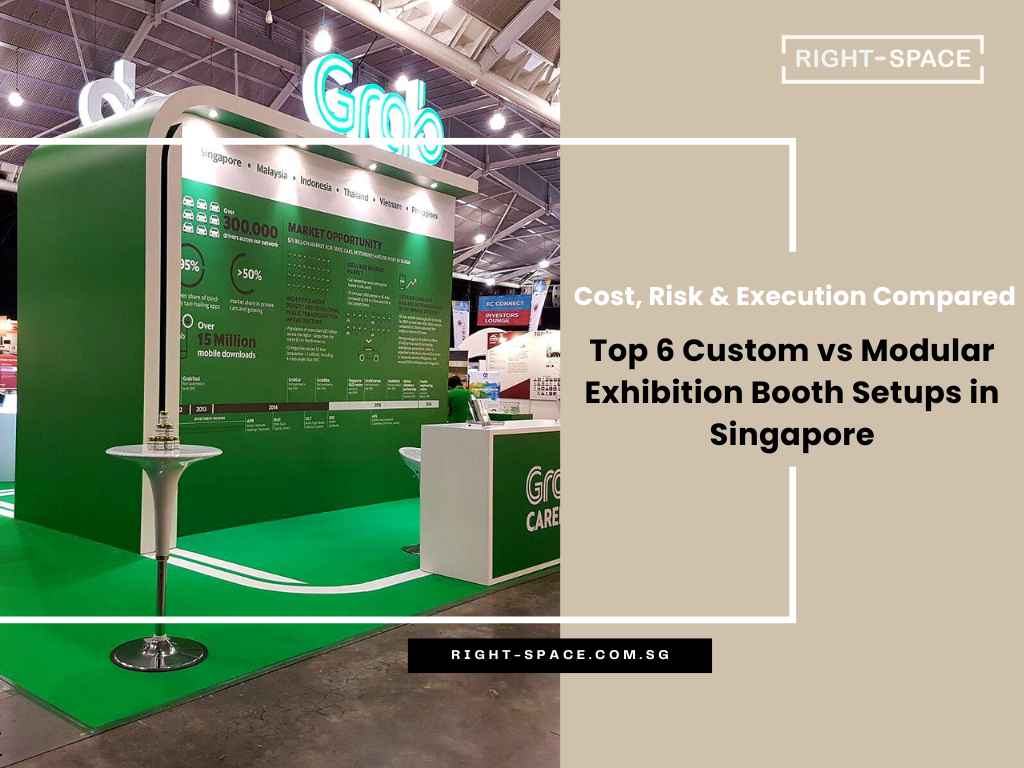
A custom exhibition booth Singapore brands commission can look perfect in 3D and still fail on show week if it cannot clear organiser rules, load-in windows, or on-site installation realities. This blog will walk you through how custom and modular booth setups really differ in cost, risk, and execution, so you can choose a setup that holds up under Singapore venue constraints.
Custom vs modular booths in Singapore: what each one really is
What a custom booth setup means in practice
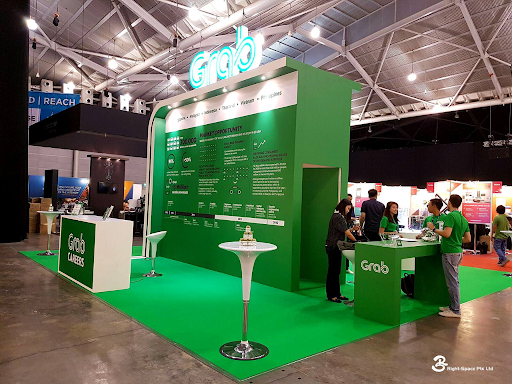
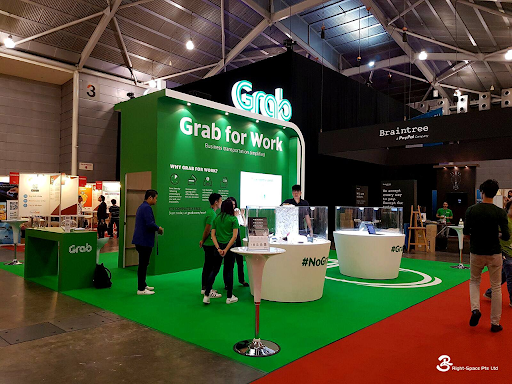
A custom booth is built around your exact footprint, story, and features. It typically uses bespoke carpentry, tailored structural frames, custom lighting integration, and branded finishes that do not rely on a standard kit.
A custom build becomes “real” only when these details are locked:
- exact booth dimensions tied to organiser drawings
- structural method and weight assumptions
- power plan and cable routing
- fabrication drawings and finish specs
- installation sequence aligned to build-up hours
If the contractor cannot produce build-ready drawings early, you do not have a custom booth. You have a concept.
What a modular booth setup means in practice
A modular booth uses a reusable system such as aluminium frames, SEG fabric walls, modular lightboxes, and standard counters that can be reconfigured across events. Graphics and layout change while the core structure stays consistent.
Modular does not mean cheap-looking. It means:
- faster production because components are standardised
- fewer unknowns at installation
- easier reuse across multiple shows
- cleaner control over lead times and rework
A good modular system still needs discipline: correct measurements, graphic file specs, and a planned layout that suits your product demo or meeting needs.
Why Singapore show conditions change the “best choice”
Singapore exhibitions are operationally strict for good reasons: safety, loading management, and hard schedule windows. Exhibitor manuals commonly define controlled loading access and marshal supervision, which punishes late staging and disorganised delivery planning. A clear example is the loading bay rules in the BCB Singapore 2025 exhibitor manual on restricted site access and marshal supervision, which describes how deliveries and unloading are managed and why contractors must follow on-site instructions.
That is why “custom vs modular” is not a style debate. It is a delivery decision under real constraints.
The Top 6 comparisons that decide cost, risk, and execution
1) Cost structure: price tag vs total cost of ownership
Custom booth cost profile
Custom builds cost more because you are paying for one-off fabrication effort:
- carpentry and fabrication labour
- bespoke finishing and paint systems
- custom joinery, edge detailing, and storage integration
- custom lighting features and wiring time
- higher QA time because fewer elements are repeatable
Cost risk shows up when approvals slip. A late change can trigger rework across carpentry, printing, and electrical, not just a graphic swap.
Modular booth cost profile
Modular spends less on fabrication but more on system selection and graphic discipline:
- initial investment in frames, connectors, counters, lightboxes
- graphics production (often recurring per show)
- packing, storage, refurbishment, and missing parts replacement
Modular becomes cheaper when you reuse it across multiple events. If you run 3 to 6 shows a year, modular can reduce the repeated “rebuild from zero” cycle.
If your team is cost-sensitive but still wants controlled execution, review Right-Space’s affordable exhibition booth design in Singapore.
2) Approval and timeline risk: what breaks when lock dates move
Custom build timeline reality
Custom is sensitive to approval drift. Small changes ripple:
- Layout changes affect structure and joinery
- New product display needs affect load assumptions
- Revised branding affects print dimensions and alignment
- Added AV affects power distribution and rigging plan
If your designer and fabricator are separated, each revision becomes a coordination delay.
Modular timeline reality
Modular absorbs late shifts better if the structure stays the same. You can:
- Reprint graphics without rebuilding walls
- Reconfigure counters and shelves using existing modules
- Change messaging without changing joinery
Modular still fails when brands treat artwork casually. Wrong file specs or last-minute copy edits create print delays that can be just as damaging as a build delay.
3) Fabrication control and QC: where finish standards are won or lost
Custom booth QC risk
Custom booths live and die on finish control. Under exhibition hall lighting, flaws show:
- inconsistent paint sheen between panels
- visible seams, edge chips, or warped boards
- misaligned graphic joins at corners
- weak hinge alignment on storage doors
You want a contractor who can define “acceptable finish” before production starts, then inspect against it before load-in.
Modular booth QC risk
Modular QC is different. The risk is system wear and tolerance:
- connector loosening over repeated setups
- bent frames from transport handling
- missing parts and mismatched hardware
- wrinkled fabric graphics due to incorrect tensioning
A strong modular workflow includes inventory control, refurbishment checks, and a defined packing method that prevents damage.
If you want a simple way to evaluate execution ownership, the exhibition booth contractor selection guide is a useful reference point.
4) Installation and logistics: what happens when load-in gets tight
Custom booth on-site reality
Custom installs can be fast or painful, depending on pre-assembly quality.
Good signs:
- test assembly in workshop
- pre-labeled components
- defined installation sequence
- a site supervisor with decision authority
Bad signs:
- “We will adjust on-site.”
- No method statement for complex elements
- Multiple subcontractors arriving without a clear order
Singapore exhibitor manuals often outline controlled loading and unloading operations, including strict supervision and timing rules. If your logistics plan is sloppy, you lose time before you even start building.
Modular booth on-site reality
Modular installs are easier when the system is truly repeatable:
- fewer cutting and drilling tasks
- less dust and mess in halls
- shorter snag lists
The fastest modular teams still plan properly. They do not rely on “it’s a kit” as an excuse to skip sequencing.
5) Flexibility and brand impact: what your setup can and cannot do
Custom booth advantage
Custom wins when you need:
- unique architecture that stops traffic
- integrated meeting rooms or semi-private zones
- heavy product demos needing strong structural support
- story-driven features like tunnels, portals, and layered depth
Custom is also better when you want your brand to look unmistakably premium in a crowded hall.
Modular booth advantage
Modular wins when you need:
- predictable brand consistency across multiple events
- flexible layouts for different booth sizes
- speed in regional or back-to-back show schedules
- cleaner shipping and simpler dismantle processes
If your objective is conversion and booth flow, not just aesthetics, the trade show booth design ideas for 2025 can help you think beyond the render.
6) Sustainability and reuse: where the industry is moving
Reusable booth systems are increasingly positioned as the practical direction for reducing single-use stand waste and improving efficiency. Singapore’s MICE ecosystem is also actively pushing event sustainability standards through initiatives such as the Singapore MICE Sustainability Roadmap and sustainability resources for organisers.
This matters commercially, not only ethically:
- Reusable systems reduce repeat fabrication cycles
- Fewer rebuilds mean fewer last-minute surprises
- Your team gets faster at setup because the system is familiar
Custom can still be responsible when designed for reuse:
- modularised custom components
- durable finishes that survive multiple installs
- storage and refurbishment planning
The key is intent. If the booth is designed as single-use, it will behave like single-use in both cost and risk.
Quick decision guide: when custom wins, when modular wins
Choose custom when
- Your booth is a flagship brand moment, not a routine presence
- You need integrated architecture (rooms, large demos, tall features)
- The show has high competition for attention and you must stand out
- You have time to lock approvals early and commit to fabrication windows
Choose modular when
- You exhibit multiple times a year and want repeatable execution
- You need flexibility across different booth sizes and locations
- You want timeline resilience when marketing assets shift late
- You want a system that can be refurbished, stored, and redeployed
A practical comparison table buyers can use in procurement
|
Decision factor |
Custom exhibition booth |
Modular booth setup |
|
Lead time sensitivity |
High |
Medium |
|
Revision cost |
High once fabrication starts |
Lower if structure stays |
|
Finish control |
High impact, high risk |
More consistent if maintained |
|
On-site installation risk |
Higher without pre-assembly |
Lower with disciplined inventory |
|
Best for |
Flagship, high-impact campaigns |
Multi-show consistency and speed |
|
Cost efficiency |
Better for one-off impact |
Better across repeated shows |
What Right-Space typically evaluates before recommending custom vs modular
Right-Space is built around execution, not just design output. The decision usually comes down to:
- Your show calendar and reuse intent
- Organiser constraints and venue load-in rules
- How stable your brand assets are before lock dates
- Your demo requirements and structural needs
- Whether you want a “campaign moment” booth or a repeatable system
Conclusion
Custom and modular booths both work in Singapore, but they fail for different reasons. Custom fails when approvals drift and fabrication starts without locked drawings. Modular fails when teams treat it like plug-and-play and ignore graphics discipline, inventory control, and sequencing.
Break the line.
If you want a booth plan that holds up under organiser rules and show-week constraints, brief Right-Space with your show date, booth size, and reuse goals so the team can recommend a setup you can defend on cost, risk, and execution.
FAQs About Custom Exhibition Booth Singapore
Is a custom exhibition booth in Singapore always more expensive than modular?
Usually yes on the first build, because custom involves one-off fabrication and finishing work. Modular becomes cost-effective when you reuse the structure across multiple shows and only refresh graphics, counters, or layout modules.
Which has lower show-week risk: custom or modular?
Modular usually carries lower installation risk because the components are repeatable, but only when inventory control and setup sequencing are managed. Custom can be reliable too when drawings are locked early and test assembly is done before load-in.
How do I decide between custom and modular for a new brand launch?
If the launch is a flagship moment with high attention stakes, custom often delivers stronger spatial impact. If you plan multiple follow-up shows, modular can protect budget and execution consistency while keeping the brand experience cohesive.
What should I ask an exhibition booth contractor in Singapore to prove execution capability?
Ask for drawings lock dates, fabrication QC sign-off process, installation sequencing plan, and who supervises on-site through snag completion. You want named owners, not “our vendors will handle it.”
Can a custom booth be designed for reuse?
Yes, if it is engineered with modularised sections, durable finishes, and a storage and refurbishment plan. Without that planning, most custom booths behave like single-use builds and become expensive to repeat.