
Exhibition Stand Builder Singapore: What to Check
25 March 2026
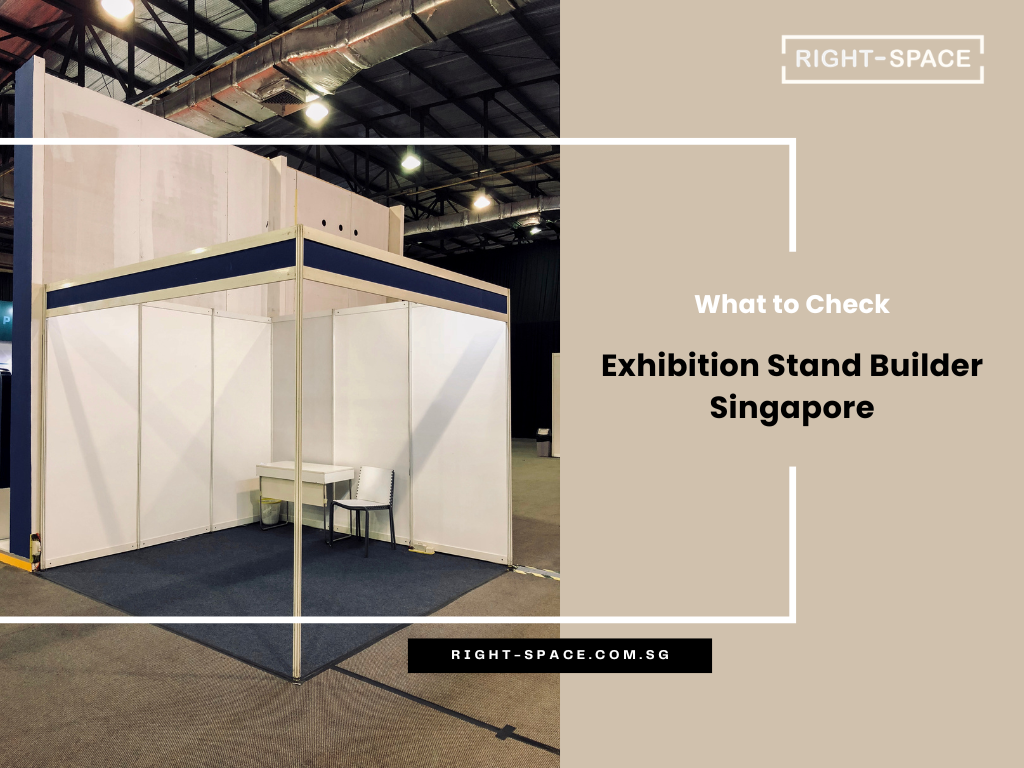
Choosing the right exhibition stand builder singapore partner affects far more than how your booth looks on opening day. This blog will walk you through what brands should evaluate before appointing a builder, from fabrication control and installation ownership to venue compliance, cost stability, and execution risk.
Brands comparing suppliers usually start by reviewing exhibition booth design services because the strongest partners do not stop at concepts. They handle design, fabrication, project management, installation, and venue coordination as one connected process. Right-Space presents its service in exactly that way, with in-house design and build capability for custom exhibition booths in Singapore.
Why builder selection matters more in Singapore than many brands expect
Singapore exhibitions run on strict deadlines and controlled venue procedures.
That matters because booth projects are not only creative exercises. They are temporary builds installed under time pressure, often inside venues with submission rules, loading restrictions, fire safety requirements, and fixed move-in schedules. Right-Space’s contractor article highlights this clearly: when something fails on-site, the problem is usually not the idea itself. It is execution ownership.
A brand can recover from a weak render with a smart revision. Recovering from fabrication delays the night before a show is much harder.
This is why procurement teams and marketing teams should not evaluate a builder on visuals alone. The real test is whether the company can turn drawings into a safe, presentable, installable stand without passing risk downstream.
What does an exhibition stand builder actually do?
A true exhibition stand contractor singapore partner is responsible for more than carpentry.
The role usually includes concept translation, technical drawing coordination, material planning, fabrication, transport, on-site installation, dismantling, and venue compliance support. Right-Space describes its own process as covering design, build, installation, and management of approvals and technical submissions, including support for venues such as Singapore EXPO and Marina Bay Sands.
That difference matters because not every supplier who presents 3D visuals owns the physical build.
Some firms focus mainly on design direction and outsource fabrication. Others coordinate multiple subcontractors. A builder with stronger stand fabrication capability usually holds tighter control over finish quality, installation timing, and problem-solving when site conditions change.
The first thing to evaluate is fabrication capability
Fabrication determines whether design intent becomes a reliable physical structure.
A supplier may speak convincingly about branding and storytelling, but if fabrication is fragmented across unrelated workshops, quality and timelines become harder to control. Precision joinery, wall alignment, graphic installation, storage integration, and finishing all depend on workshop standards.
Strong fabrication capability typically includes:
- In-house or tightly controlled workshop operations, ensuring consistent quality
- Familiarity with materials such as laminates, acrylic, lightboxes, and metal framing
- Ability to respond to revisions before fabrication lock
- High build accuracy, including clean alignment and concealed joints
If a builder cannot clearly explain how the stand will be fabricated, not just designed, that is a warning sign.
Booth construction process should be transparent, not vague
A reliable builder should be able to walk you through the full booth construction process in plain terms.
That process usually includes briefing, concept development, design refinement, technical drawings, materials confirmation, fabrication, pre-install checks, site installation, and dismantling. Right-Space’s timeline article states that most custom booths should start planning 20 to 24 weeks before the show for major Singapore exhibitions with strict approval timelines.
That does not mean every project needs six months. It does mean serious builders understand sequencing.
When brands choose partners too late, compress approvals, or keep revising the layout after fabrication should already have started, costs become unstable. Build quality can suffer as well.
This is why the exhibition booth design timeline in Singapore matters during vendor selection. It helps brands evaluate whether a supplier is planning a real production schedule or simply promising a fast turnaround.
Installation ownership is where accountability becomes visible
Installation is the least forgiving phase of the project.
Even a well-designed stand can fail due to damaged components, missing graphics, incorrect sequencing, or non-compliant structural details.
Installation ownership determines who:
- Submits technical drawings and calculations
- Coordinates transport and move-in schedules
- Manages rigging and electrical works
- Handles touch-ups and last-minute fixes
- Communicates with venue operations
If responsibility is spread across multiple parties, accountability may weaken.
Execution-led builders manage these tasks directly, reducing risk during critical installation windows.
Brands trying to understand this distinction more clearly should read the guide on exhibition booth contractor versus designer, because execution ownership is often the factor that protects both budget and event readiness.
Venue compliance is not optional in Singapore
This is one of the biggest reasons builder selection matters.
Exhibition venues in Singapore do not operate on informal setup logic. Organisers and venues issue exhibitor manuals, stand regulations, health and safety requirements, and contractor procedures that shape what can actually be built and when. For example, event manuals for Marina Bay Sands-hosted exhibitions state that stand contractors must adhere to workplace safety and health guidelines, and some events require mandatory safety briefings for contractors working on site.
That has direct implications for partner choice.
A builder who has handled venue submissions before will understand drawings, risk assessments, power coordination, installation windows, and site safety requirements. A supplier who mainly thinks in terms of visual design may leave these issues too late.
Right-Space’s service page notes support for technical drawings, submission documents, and risk assessments. That kind of support is not a bonus in Singapore. It is part of competent delivery.
Brands should judge a builder by how they think about visitor experience
A stand is not only a built object. It is a temporary sales and engagement environment.
This is where layout capability matters. A good builder should be able to discuss traffic flow, sightlines, product display logic, storage placement, message hierarchy, and how visitors will actually use the booth. Right-Space’s article on event space planning links layout, visitor flow, wayfinding, and spatial psychology, which is highly relevant to exhibition stands as well.
That evaluation is important because flashy design can still perform badly if the front edge is blocked, the demo area is cramped, or the conversation zone is too exposed.
Brands that want a stronger benchmark for this should study creative booth design inspiration for Singapore trade shows. The better examples work because they manage attention and movement well, not because they add decoration for its own sake.
Cost stability is a better metric than the cheapest quote
Many brands initially compare suppliers by headline price. However, the lowest quotation is not always the most economical.
Costs often increase later if important elements were excluded from the original proposal, such as supervision, coordination, or dismantling.
A comprehensive quotation typically includes:
- Design and drawings concept development, layout planning, visualisation, revisions
- Fabrication structural build, walling, counters, graphics, branded elements
- Installation labour, transport, unloading, assembly, touch-ups
- Technical compliance submission drawings and coordination
- Dismantling removal and site clearance
Instead of asking only “What is the price?”, brands should ask “What risks are covered within this price?”
For budget context, affordable exhibition booth design options in Singapore can be useful, especially for brands comparing custom builds against more controlled modular or cost-managed approaches.
Market reality: brands need partners who can execute, not just advise
The exhibition industry remains commercially important, and that raises the standard for delivery.
UFI reported in early 2026 that the global exhibition sector continued to show positive momentum, with many markets reporting activity growth in 2025. UFI’s 2025 global statistics also estimated around 32,000 exhibitions worldwide in 2024, which reinforces how established and operationally demanding this channel still is.
In a market where exhibition participation still commands real budgets, brands do not benefit from vague project ownership.
They need stand partners who can connect design intent, fabrication control, venue compliance, and installation logistics into one accountable workflow.
That is the context in which Right-Space’s core positioning makes sense. The company presents itself not only as a booth designer, but as a Singapore-based creative event agency involved in immersive event marketing, exhibition booth design, commercial interior design, and experiential execution across Southeast Asia.
What brands should check before appointing a builder
A short vendor checklist helps separate polished presentations from real delivery capability.
- Ask who owns fabrication and where it happens.
- Ask who installs the stand and manages site coordination.
- Ask what venue submissions are included.
- Ask for examples of similar complexity, not only similar style.
- Ask how late changes are handled once the build schedule is locked.
- Ask what the quote excludes.
- Ask how visitor movement and booth function were considered in the layout.
If the answers are specific, operational, and easy to follow, the builder probably understands the work.
If the answers stay broad, visual, or sales-heavy, dig deeper.
Conclusion
The right stand partner is not the one with the nicest render. It is the one that can build, install, coordinate, and protect the project when deadlines tighten and site conditions become real.
If your team is evaluating suppliers for an upcoming exhibition, speak with Right-Space about a build process grounded in fabrication control, venue compliance, and accountable on-site delivery.
FAQs About Exhibition Stand Builder Singapore
What does an exhibition stand builder in Singapore actually handle?
A proper builder handles design translation, fabrication, installation, logistics, and venue coordination. Right-Space positions its exhibition service around end-to-end delivery rather than concept-only work.
What is the difference between an exhibition stand builder and an exhibition stand contractor?
In practice, the terms often overlap. The key issue is whether the company owns fabrication and installation. Right-Space’s contractor guide explains that execution ownership is what separates delivery-led partners from design-only vendors.
Why does stand fabrication capability matter so much?
It affects finish quality, lead time, revision control, and installation speed. When fabrication is fragmented, quality and accountability usually become harder to manage.
Do Singapore exhibition venues require safety compliance from stand contractors?
Yes. Exhibitor manuals and venue rules commonly require adherence to workplace safety and health guidelines, and some events at Marina Bay Sands require contractor safety briefings.
How early should brands appoint an exhibition stand builder?
It depends on scope, but custom projects should not be left to the last minute. Right-Space’s timeline article notes that major booth projects may need planning to begin 20 to 24 weeks ahead for larger exhibitions.