

Experiential Retail Design Singapore 2026: Brand Stores
12 October 2026
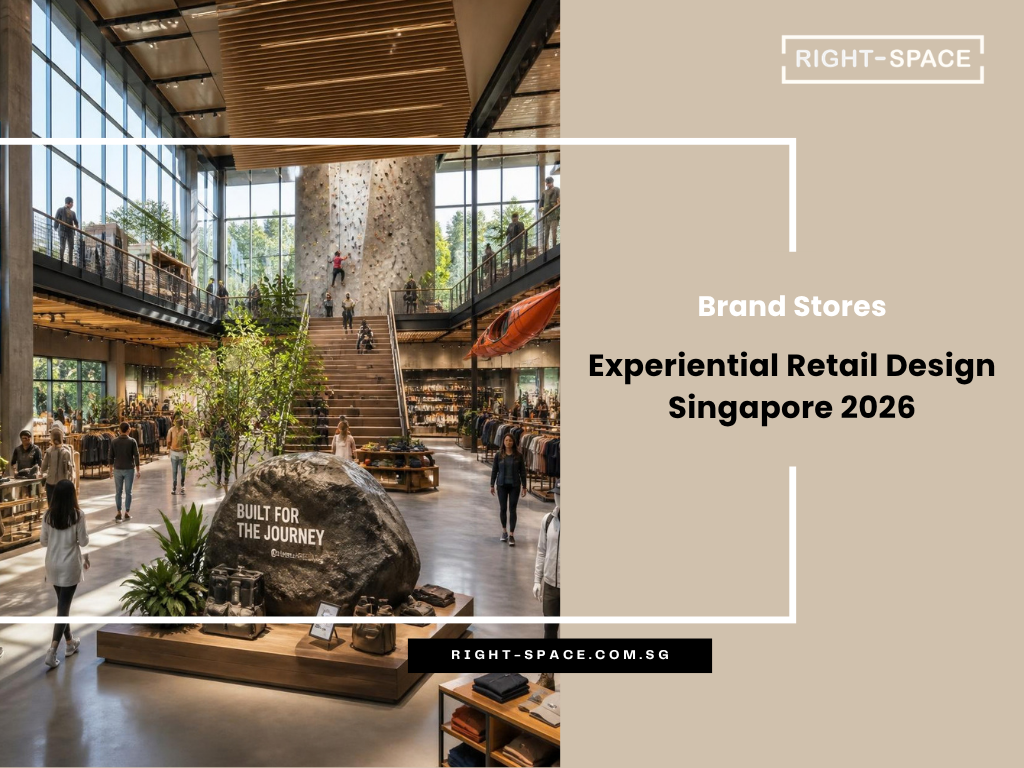
Experiential retail design turns a Singapore store into a brand world that shoppers visit for the experience as well as the product. It works when five layers are planned together: story, senses, interaction, a share moment and a programme that keeps changing. Written for brand and retail managers planning a flagship, concept store or pop-up.
Experiential retail design is the planning of a store as a brand world: the space, materials, sensory cues, interactive features and events are designed so that visiting the store becomes an experience people choose, remember and share, with the product sold inside that experience. Singapore received 16.9 million international visitors in 2025 (STB). Right-Space’s commercial interior design and build team delivers these spaces.
The brand world stack: five layers of an experiential store
An experiential store works when five layers are designed as one system: the story the space tells, the senses it engages, the interactions it offers, the moment people share, and the programme that changes it over time. Drop one layer and the store reads as decoration.
|
Layer |
What it does |
Build decision |
What to measure |
|
1. Story (brand world) |
Gives the space one idea to express |
Architecture, materials, signature feature |
Recall in post-visit surveys |
|
2. Senses |
Makes the idea felt as well as seen |
Scent, sound, texture, light |
Dwell time by zone |
|
3. Interaction |
Lets shoppers try, test or personalise |
Try-on, sampling, AR, workshops |
Interactions per visitor |
|
4. Share moment |
Gives visitors one image worth posting |
Photo point placed off the sales path |
Tagged posts, user content |
|
5. Programme |
Gives people a reason to return |
Events calendar, rotating installations |
Repeat visits, CRM sign-ups |
Retail brand experience starts with layer one. A store with a clear story can absorb modest budgets elsewhere. A store without one spends heavily on screens and scent and still feels generic.
Why experiential retail matters in Singapore in 2026
Experiential retail matters in Singapore because both shoppers and visitors are spending on experiences, and the government and industry are actively pushing people back into physical stores. The data from 2025 shows where money moved.
Singapore welcomed 16.9 million international visitors in 2025, and tourism receipts reached S$23.9 billion in the first nine months, up 6.5%. Growth was led by sightseeing, entertainment and gaming, and food and beverage, each up 15%. STB chief executive Melissa Ow said Singapore is “attracting visitors who value the distinctive experiences that Singapore offers.” STB forecasts 17 to 18 million visitors in 2026.
Local shoppers follow the same pattern. At the SRA Retail Awards on 25 September 2025, Senior Minister of State Low Yen Ling said consumers “are in fact returning to physical stores for immersive and personal experiences.”
The same speech launched the Singapore Retail Festival, run by the Singapore Retailers Association with Enterprise Singapore support from 26 September to 12 October 2025. It also announced Red Label at Kallang Wave Mall, billed as Singapore’s first unmanned retail experience concept, with 10 brands across three zones.
A flagship in Singapore now competes with attractions and restaurants for the same afternoon. Design it to win that comparison.
Flagship lessons from a Singapore brand world
The clearest brand world in Singapore retail is Apple Marina Bay Sands, which opened on 10 September 2020 as the first Apple Store to sit directly on water. Its lesson is that one strong architectural idea and one strong programme carry an entire store.
The store is an all-glass, self-supported dome built from 114 pieces of glass with 10 narrow vertical mullions, inspired by the Pantheon in Rome. Inside, a video wall anchors a forum used for Today at Apple sessions featuring Singapore artists, musicians and creators. The architecture tells the story once. The programme gives people a reason to come back.
Most brands work at a smaller scale, and the principle holds. A brand world can be a material palette, a signature fixture and a consistent sequence of spaces, repeated outlet after outlet. Right-Space delivered this for Joy Luck Teahouse’s expansion in Singapore: designers created the key visuals once and adapted them to each location, and in-house carpenters built every element from scratch. The teahouse rollout across outlets opened each shop on schedule.
Pick one idea and build everything around it. Three competing ideas in one store read as clutter.
Sensory design that shoppers remember
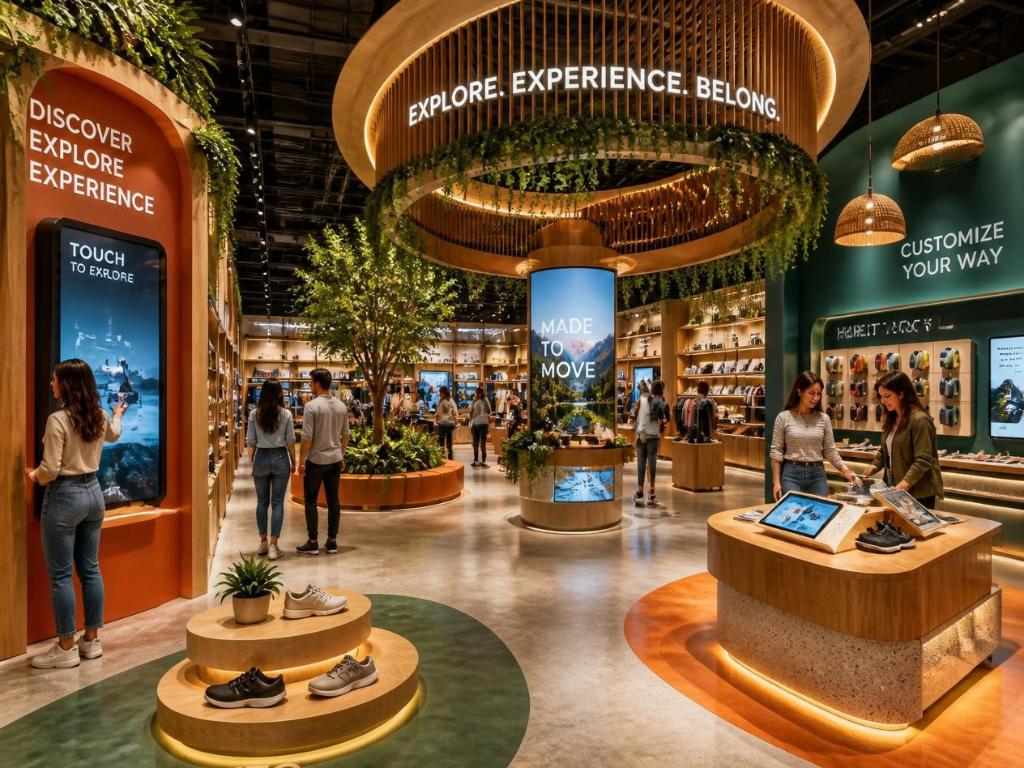
Sensory design works when every sense points to the same idea. Scent, sound, texture and light that agree with the brand and the product strengthen the experience; cues that clash weaken it.
The research supports a positive effect with limits. A 2024 meta-analysis in the International Journal of Retail & Distribution Management found pleasant ambient scent improved consumers’ affective, cognitive and behavioural responses in both retail and hospitality, with stronger cognitive and behavioural effects in hospitality than in retail. Scent alone will not carry a store. It works as one layer among several.
Plan the senses zone by zone. A sampling bar earns scent and touch. A fitting area earns warmer light and quieter sound. A product wall earns accurate colour rendering so the shade a customer sees in store matches what arrives at home. Choose materials the customer will touch on purpose: the counter edge, the display surface, the door handle.
Right-Space built the Armani Beauty Box pop-up for L’Oréal outside Tangs on Orchard Road in 2021, where finish and texture had to carry a luxury brand at street level. The broader method for translating identity into material and mood is covered in our guide to sensory branding inside interiors.
Interactive store design: when technology earns its floor space
Interactive technology lifts the retail experience when it matches the product and the shopper’s task, and adds little when it is installed for novelty. Give every screen, mirror or AR feature a job before it gets floor space.
The evidence base is now large. A 2025 meta-analysis of augmented and virtual reality in retail by Fan, Xun, Dolega and Xiong in Sustainability pooled 1,099 effect sizes from 111 studies covering 547,415 participants. It found significant positive links between AR and VR experiences and customer experience, attitude, purchase intention and loyalty, and confirmed that the effect varies with technology type and product type.
Translate that into briefs. AR try-on suits products where fit or colour is the barrier to buying, such as eyewear, cosmetics and furniture. Sampling stations suit products that must be smelled or tasted. A large video wall suits stores that run talks and events. A touchscreen catalogue in a store with full stock on the shelf solves nothing.
Plan content alongside hardware. Interactive features need updating, staff who can demonstrate them and a fallback when they fail. Budget for all three.
Designing social-worthy moments without crowding the shop floor
A social-worthy store gives visitors one strong image to share, placed where taking the photo does not block shopping. One clear moment beats several weak ones.
Scale and surprise travel furthest online. Right-Space built a 7-metre live Jia Jia bottle at Plaza Singapura in 2022, and passers-by stopped to photograph it. Size alone is not the point. The object was the product itself, so every photo carried the brand.
Place the photo point at the edge of the sales path, light it for phone cameras, and give it a backdrop that names the brand without a caption.
Do you need consent to photograph shoppers in store?
Yes, when the brand itself captures or uses images of identifiable shoppers. Under the PDPC’s Advisory Guidelines on the PDPA for Selected Topics (revised May 2024), an organisation taking photographs or video of an individual must meet the Notification and Consent Obligations under the Personal Data Protection Act 2012 unless an exception applies. Notices should state that photography or recording is taking place.
Build the notice and consent step into any photo booth, AR mirror that saves images, or email-capture screen.
Flagship or pop-up: choosing the format
Choose a permanent flagship when the brand needs a lasting home that anchors its story, and a pop-up when the goal is a launch, a test of a new location or a short burst of attention. Many brands do best with both: a permanent shell with an experience layer that changes.
Design the change into the build. Keep the shell, lighting grid, power and services fixed, and make feature walls, plinths and installations modular so they can be swapped without hacking. That approach keeps the programme layer alive without reopening the whole fit-out. Right-Space builds roadshows, pop-ups and custom fabrication in-house, which suits modular experience layers that are made off-site and installed overnight.
Immersive installations bring rules with them. SCDF treats works involving combustible materials as fire safety works requiring plan approval, so fabric ceilings, foam forms and timber-heavy installations need a Qualified Person’s check before design is frozen. Our guide to scope and approvals before building covers that sequence.
On cost, Right-Space’s published starting point for commercial interior projects is around S$50,000, with standard projects taking 6 to 12 weeks. Interactive technology, custom installations and content production sit on top of the fit-out budget.
How to measure a retail brand experience
Measure each layer of the brand world stack against a baseline taken before opening or before a refresh: footfall and dwell time for the space, interactions per visitor for features, tagged posts for the share moment, and repeat visits and consented sign-ups for the programme. Sales per square foot remains the final test.
Footfall counters and zone-level dwell tracking show whether the senses and interaction layers hold people. Social listening shows whether the share moment travels. CRM data shows whether the programme brings people back. Collect any personal data through the consent flow described above. Match the review cycle to the programme: when installations change each quarter, read the numbers each quarter, against the same weeks a year earlier.
Store-level mechanics sit underneath these brand measures. For threshold capture, dwell and conversion benchmarks at the store front, see our breakdown of stop-and-stay store metrics.
Build the story first
Experiential retail design pays off when the brand world comes first and every other layer serves it. Singapore’s 2025 numbers show visitors and residents spending on experiences, and the evidence on sensory cues and interactive technology shows both work best when they match the product. The stores that last keep the shell fixed, change the experience layer on a planned calendar, and respect the consent and fire rules that come with immersive features.
Planning a flagship, concept store or pop-up? Start a design consultation with Right-Space’s team to map your brand world before anything is built.
Frequently asked questions
What is experiential retail design?
Experiential retail design plans a store as a brand world, using space, materials, sensory cues, interactive features and events so that visiting becomes the reason to come. Apple Marina Bay Sands, opened in Singapore in September 2020 as a glass dome on the water with a programmed forum, is a clear local example.
What are examples of experiential retail in Singapore?
Apple Marina Bay Sands (2020) built its brand world into a 114-panel glass dome on Marina Bay. Red Label at Kallang Wave Mall, scheduled to open in October 2025 with Enterprise Singapore support, was announced as Singapore’s first unmanned retail experience concept, with 10 brands across three curated zones.
Does interactive technology increase retail sales?
The evidence shows it raises purchase intention and loyalty when matched to the product. A 2025 meta-analysis of 111 studies on augmented and virtual reality in retail found positive links to customer experience, attitude, intention and loyalty, with effects varying by technology and product type. Measure sales against a baseline to confirm.
Do I need consent to photograph customers at an in-store activation in Singapore?
Yes, when your brand captures or uses images of identifiable people. PDPC’s Advisory Guidelines on the PDPA for Selected Topics, revised in May 2024, require organisations to meet the Notification and Consent Obligations for photography and video unless an exception applies. Display clear notices at photo points.
How much does experiential retail design cost in Singapore?
Right-Space’s published starting point for commercial interior projects is around S$50,000, with standard projects taking 6 to 12 weeks. Experiential stores add interactive technology, custom installations and content on top of the fit-out, so the final figure is set by how many of the five layers the brief includes.
Related Insights
Browse our latest articles on event management, exhibition design, and brand activation in Singapore.
View All Insights