

Product Launch Event Planning Singapore: Timeline
29 August 2026
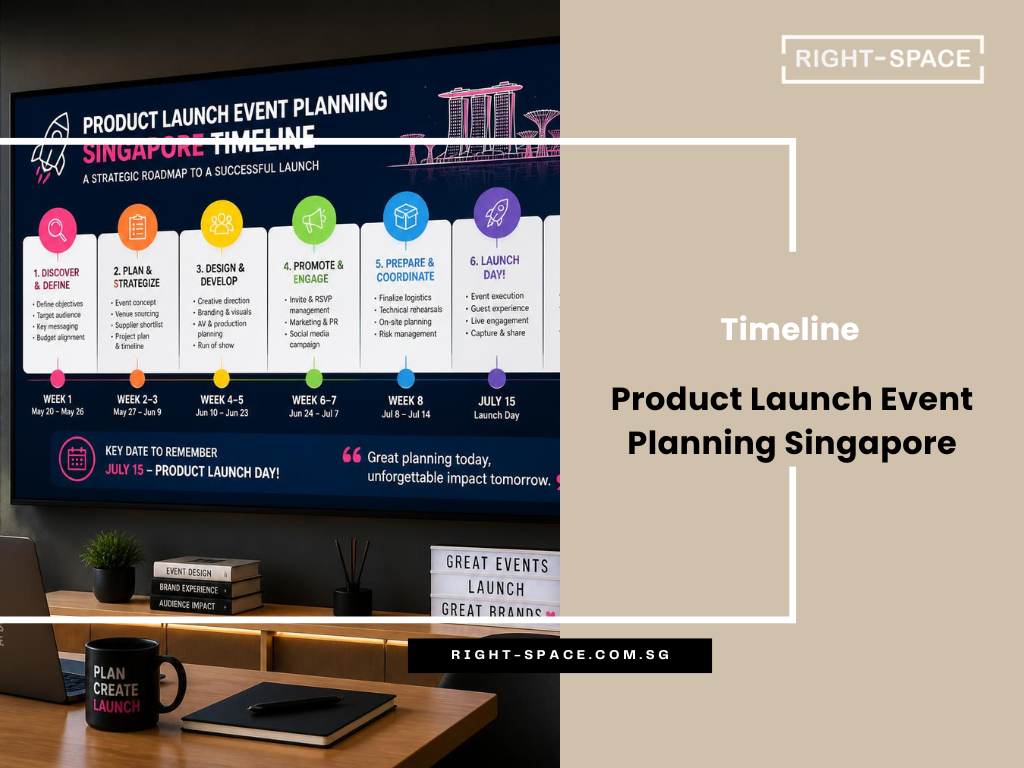
Product launch event planning in Singapore works backwards from one fixed date, the go-live, because everything else has to land before it. Singapore’s business events sector contributes over SGD 3.7 billion to the economy, and the launches that run cleanly are the ones planned to a calendar, not to good intentions. This blog walks you through the timeline and checklist, milestone by milestone. Start with our event marketing and production scope.
How do you plan a product launch event in Singapore?
You plan a product launch by fixing the go-live date first, then working backwards to schedule every milestone that must happen before it. The go-live is the one date that does not move, so the plan is a countdown, not a forward march. Each phase, concept, design, fabrication, approvals, install, and rehearsal, is placed against the launch date in the order and lead time it requires.
Planning forwards from today is where launches slip. A team that starts with today’s date and works forward runs out of calendar before go-live and compresses the phases that need the most time. Planning backwards exposes immediately whether the date is achievable and where the tight points are. Plan backwards from go-live, never forwards from today, because only a countdown shows you, early enough to act, whether the launch you want fits the time you have.
How far ahead should you start planning?
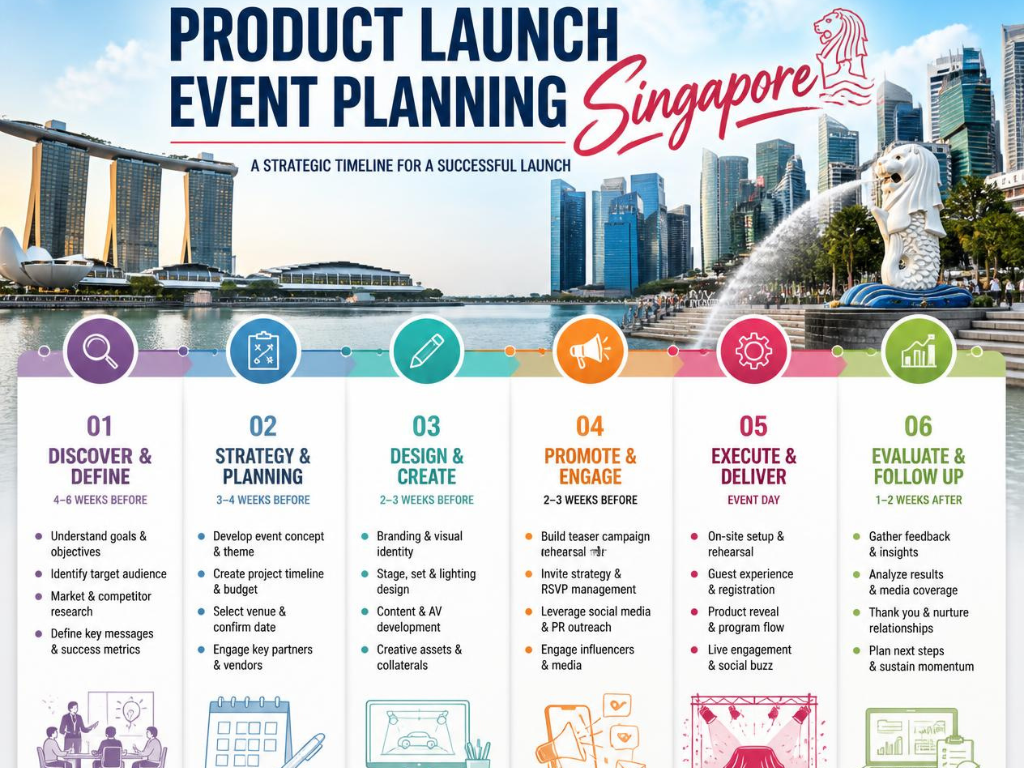
Start planning as soon as the launch date is fixed, and engage a production partner at least two to three months ahead, with more time for a custom build. Right-Space recommends reaching out at least two to three months in advance for live events, and a launch with a bespoke built environment needs three to six months, since design, fabrication, and approvals each take real weeks. Commonly cited industry planning minimums put even a simpler launch at six weeks or more.
Lead time decides what is possible, not just what is comfortable. A launch planned three to six months out can carry a custom environment, a rehearsed reveal, and cleared permits, while one started a few weeks out is limited to what can be booked and assembled fast. The earlier the start, the more launch you can actually deliver. Confirm the date and engage the partner early, because lead time is the one input that, once spent, cannot be bought back at any price.
What does the planning timeline look like, week by week?
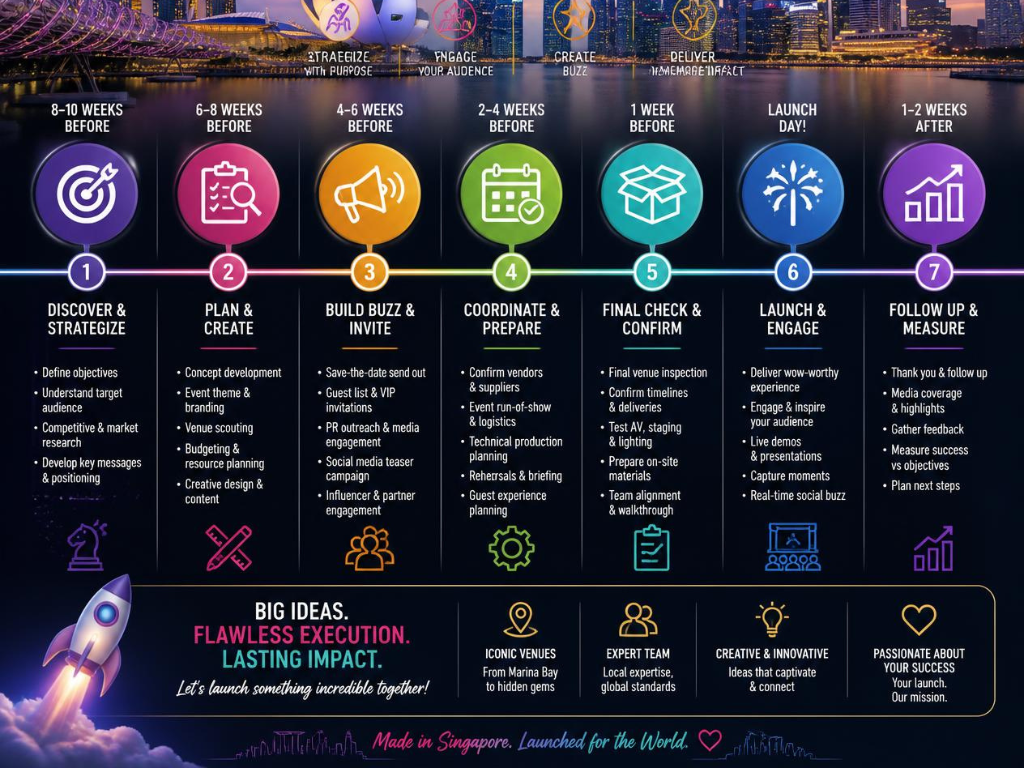
A launch planning timeline runs in phases against a go-live date: brief and partner selection first, then concept and design, then fabrication, then approvals and logistics, then install and rehearsal, then go-live. Working backwards from a typical mid-scale launch, the brief, budget, and partner are set at around T-minus three to six months. Concept and design run to roughly T-minus eight to ten weeks, fabrication occupies the weeks after, approvals and logistics run in parallel, and install and rehearsal land in the final week before go-live.
The phases overlap, which is why a written timeline matters. Approvals are submitted while fabrication is underway, and logistics are planned before the build finishes, so a shared countdown keeps parallel workstreams from colliding. Each phase hands to the next at a defined milestone, not on a vague “when it’s ready.” Map every phase to a T-minus date at the start, because a launch timeline held only in someone’s head is a timeline that discovers its problems too late to fix them.
What is a design freeze, and when does it happen?
A design freeze is the milestone where the launch design is finalised and locked, ending changes so fabrication can begin, and it typically lands around T-minus eight weeks for a mid-scale launch. Up to the freeze, the concept, layout, and reveal are refined and approved, ideally after 3D visualisation confirms the design works. After the freeze, the design is fixed and fabrication proceeds against a stable target.
The design freeze is the most important date in the calendar after go-live, because everything downstream depends on it. This is where the design is developed and approved, the point where where the design is developed becomes a locked plan rather than a moving idea. A design that keeps changing after the freeze pushes fabrication late and threatens the whole timeline. Hold a hard design freeze and mean it, because every change after the freeze eats days the fixed go-live date cannot give back.
What is a fabrication lock, and why does it matter?
A fabrication lock is the point where materials, finishes, and build specifications are confirmed and fabrication starts in the workshop, usually just after the design freeze. It commits the build to physical production, so the specifications have to be final: dimensions, finishes, structural method, and integrated AV or lighting. Once the workshop begins cutting and building, changes cost material and time.
The lock matters because it turns a design into a physical object against a deadline. Building in-house keeps this phase controlled, the discipline behind how a build is made buildable, with Right-Space fabricating in a 25,000 square foot workshop rather than subcontracting. Pre-assembly before load-in is scheduled here too, so faults surface in the workshop, not at the venue. Lock fabrication only when specifications are genuinely final, because a build restarted mid-fabrication because of a late change is the fastest way to miss a launch date.
When do venue and permit submissions need to go in?
Venue confirmations and permit submissions must go in early, because both run on external timelines the launch cannot control. The venue should be booked at the brief stage, since prime spaces and dates get taken months ahead. Permit and approval submissions, including any that fall under SCDF’s Temporary Change of Use guidance for enclosed or temporary structures, need to be lodged well before install, since approval takes time that sits outside the team’s control.
These deadlines catch teams that treat approvals as paperwork rather than lead time. A permit lodged late holds up an install that has nowhere else to move, and a venue booked late narrows the whole plan to its availability. Submissions have to be scheduled as milestones, not handled at the end. Treat permits as a lead-time problem, not a paperwork problem, because an approval that arrives after the install window has opened can stop a launch that is otherwise ready.
What is a run-of-show, and when is it finalised?
A run-of-show is the minute-by-minute script of the launch, listing every cue for staging, lighting, sound, video, and speakers, and it is drafted during production and finalised before rehearsal. It sequences the entire event, so the reveal, speeches, and entertainment land in order and on time. The draft evolves through the fabrication and production phase and locks in the final week, ahead of rehearsal.
The run-of-show is what turns separate elements into one show, and it is the backbone of how the show stays controlled on the night. A stage manager runs the launch against it, calling cues so the reveal fires exactly when intended. A launch without a finalised run-of-show improvises its most important moments. Finalise the run-of-show before rehearsal, because you cannot rehearse a show that is not yet written, and an unrehearsed reveal is a gamble taken in front of the audience.
Why does rehearsal matter, and when does it happen?
Rehearsal matters because it is the only time the launch runs before the audience sees it, and it happens in the final days, ideally on the built stage. A full rehearsal runs the run-of-show against the actual staging, lighting, sound, and reveal mechanism, so timing, cues, and transitions are tested and fixed while there is still time. It is the difference between a reveal that lands and one seen for the first time on the night.
The rehearsal has to use the real environment, not a mental walkthrough. Running the reveal on the installed set, with the actual the live production layer in operation, is what catches the cue that fires late or the sightline that fails. Skipping rehearsal to save a day is a false economy that risks the whole launch. Rehearse the full show on the built stage before go-live, because a launch you did not rehearse is a launch you are seeing for the first time at the same moment your guests are.
What does launch week and go-live look like?
Launch week is load-in, install, tech rehearsal, go-live, and then dismantle, compressed into a tight sequence around the fixed date. Load-in and install happen in the days or overnight windows before the launch, erecting the build in sequence within the venue’s access rules. Tech rehearsal and a full run-through follow once the environment is up, then go-live, then dismantle and load-out after the event.
This is the week where planning either pays off or unravels. A well-planned launch arrives at launch week with a built, pre-assembled scheme, a finalised run-of-show, and cleared approvals, so the week is execution, not firefighting. A poorly planned one spends launch week solving problems that should have been closed months earlier. Protect launch week by closing every upstream milestone on time, because launch week has no slack to absorb the failures of the months before it.
What should the product launch planning checklist include?
A launch planning checklist should track every milestone from brief to measurement against its T-minus date. The essential items, grouped by phase:
Brief and setup (T-minus 3 to 6 months): confirm objective and audience; set budget with contingency; select and engage the production partner; book the venue; lock the go-live date.
Concept and design (to T-minus 8 to 10 weeks): develop concept and reveal; approve 3D visualisation; hold the design freeze.
Fabrication and approvals (T-minus 8 to 3 weeks): confirm the fabrication lock; begin the build; submit venue and permit approvals; plan logistics and install.
Production and rehearsal (final 1 to 2 weeks): finalise the run-of-show; confirm entertainment and AV; complete rehearsal on the built stage.
Launch week: load in and install; run tech rehearsal; go live; dismantle and load out.
Post-launch: capture measurement against the objective; store reusable build elements.
You can find more planning detail in more event and planning guides from Right-Space. Work the checklist against real dates, because a checklist without a T-minus date on every line is a wish list, not a plan.
Conclusion
Planning a product launch in Singapore is a countdown from a fixed go-live date. Fix the date, work backwards, and hold the two gates that protect the timeline: the design freeze that ends changes and the fabrication lock that starts the build. Submit permits early, finalise the run-of-show before rehearsal, and rehearse on the built stage. Do that and launch week becomes execution rather than rescue, and the launch lands exactly when it was always meant to.
Planning a product launch and want the timeline handled properly? Ask Right-Space to build your launch schedule and deliver the design, fabrication, and show against every milestone, so go-live arrives ready rather than rushed.
FAQs About Product Launch Event Planning ingapore
How long does it take to plan a product launch event?
A product launch needs at least two to three months, and three to six months for a custom-built event. Right-Space recommends engaging two to three months ahead for live events, with bespoke builds requiring longer for design, fabrication, and approvals. Commonly cited industry minimums put even a simpler launch at six weeks or more.
What is the first step in planning a launch?
The first step is fixing the go-live date and the objective, then working backwards to schedule every milestone. Once the date is set, Right-Space builds the countdown: partner and venue at T-minus three to six months, design freeze around T-minus eight weeks, and rehearsal in the final week. The date anchors everything else.
Can you plan a product launch in a month?
A small, simple launch can be assembled in a month, but a custom-built launch cannot, because fabrication and approvals need more time. Right-Space recommends two to three months minimum, since a one-month timeline rules out a bespoke environment, cleared permits, and proper rehearsal. A rushed launch is limited to what can be booked fast.
What is a run-of-show in event planning?
A run-of-show is the minute-by-minute script of a live event, listing every cue for staging, lighting, sound, video, and speakers in order. For a launch, it choreographs the reveal. Right-Space finalises the run-of-show before rehearsal and runs the event against it, with a stage manager calling cues on the night.
Related Insights
Browse our latest articles on event management, exhibition design, and brand activation in Singapore.
View All Insights