

Seasonal Event Decoration Singapore: Beyond Christmas
18 July 2026
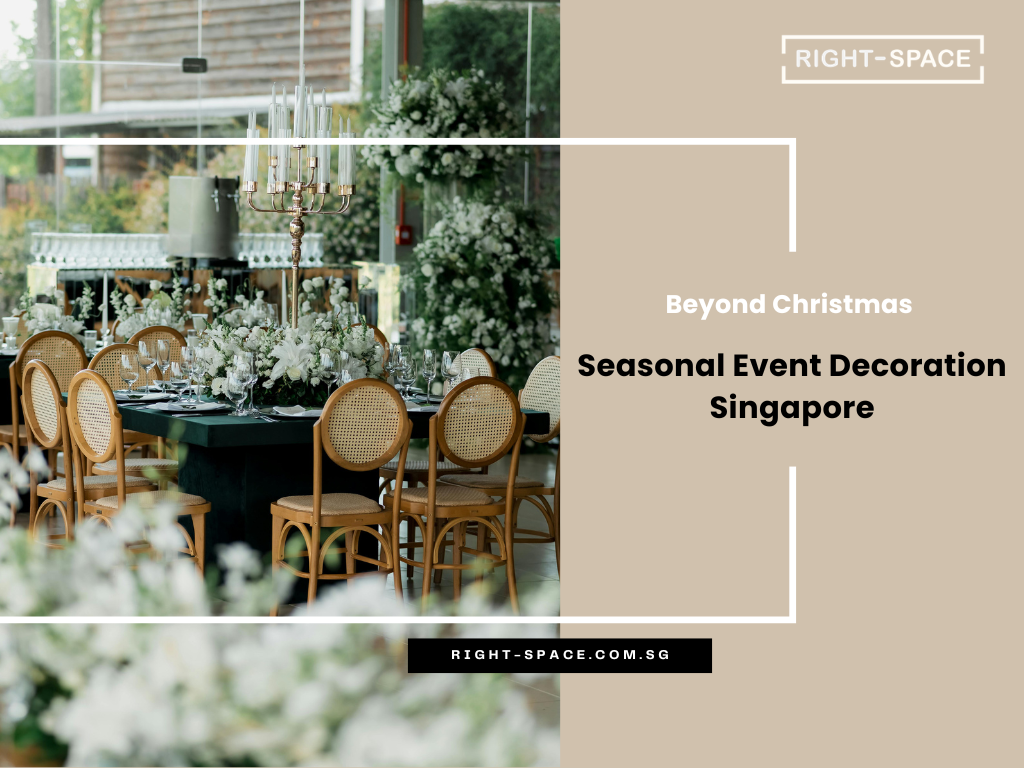
Seasonal event decoration in Singapore runs on a calendar of at least five festivals, not one December peak, which is what separates a year-round activation programme from a Christmas afterthought. Singapore observes major public holidays across Chinese New Year, Hari Raya, Deepavali, and National Day, and brands activate for each. This blog walks you through decorating activations beyond Christmas. It draws on Right-Space’s event marketing and activation scope.
What is seasonal event decoration, and how is it different from Christmas decor?
Seasonal event decoration is the design and installation of festival-tied activation schemes that turn a retail or public space into a branded experience for a specific occasion. It differs from Christmas decor in cultural specificity and cadence: instead of one December scheme, brands run distinct activations across Chinese New Year, Hari Raya, Deepavali, and National Day. Each festival carries its own colours, motifs, and cultural meaning that a scheme has to respect.
The distinction is strategic, not decorative. A Christmas-only approach leaves a brand invisible during the other four occasions when footfall and cultural relevance peak. Singapore’s multicultural calendar gives brands multiple high-traffic moments a year, each with its own audience and mood. Treat seasonal decoration as a rolling activation calendar, because a brand that shows up only at Christmas misses four of the five moments its customers are actually celebrating.
Which seasons and festivals do brands activate for in Singapore?
Brands in Singapore activate for at least five occasions: Chinese New Year, Hari Raya Puasa, Deepavali, National Day, and Christmas. These anchor the retail and corporate calendar because each is a gazetted public holiday with its own shopping and gathering peak, listed on Singapore’s official public holiday calendar. Chinese New Year falls in late January or February, Hari Raya shifts earlier each year on the lunar calendar, Deepavali lands around October or November, and National Day is fixed on 9 August.
The calendar shapes how a brand plans. A mall or retailer running all five needs a rolling programme where one activation strikes and the next installs within weeks, which compresses design and fabrication cycles across the year. Each festival also targets a different community and mood, so a single generic scheme cannot serve them. Map the full year of festivals first, because a brand planning activation by activation always ends up rushing the next one.
How do you decorate a Chinese New Year activation?
A Chinese New Year activation is built on prosperity symbolism, using red and gold, auspicious motifs, and a hero centrepiece that reads as celebratory and premium. The palette is specific: red and gold dominate, with motifs like blossoms, lanterns, the zodiac animal of the year, and mandarin oranges. The zodiac animal changes annually, so a CNY scheme is partly rebuilt each year around the new sign.
The strongest CNY activations turn symbolism into a photo destination. A large lantern installation, a blossom archway, or a zodiac centrepiece gives shoppers a reason to stop, photograph, and share, which is the mechanism behind an atrium activation that lifts footfall. Reunion and gifting drive CNY spending, so the decor should frame the brand as part of that ritual rather than decorating around it. Anchor a CNY activation on the year’s zodiac and a shareable centrepiece, because a scheme that reuses last year’s animal reads as recycled during the most symbolically precise festival of the year.
How do you approach Hari Raya decoration for a brand?
Hari Raya decoration centres on warmth, festivity, and togetherness, using motifs like the ketupat, crescent and star, pelita lamps, and geometric Islamic patterns in green, gold, and jewel tones. Hari Raya Puasa marks the end of Ramadan, so the mood is celebratory and communal after a month of fasting. The design language is distinct from CNY and cannot be swapped: the motifs, patterns, and palette carry specific cultural meaning.
Authenticity is what makes a Hari Raya activation land. Ketupat forms, pelita lighting, and traditional patterns should be rendered with respect and accuracy, not as generic decoration with a crescent added. The best schemes evoke the open-house tradition of visiting and hospitality that defines the festival. Design Hari Raya decor from genuine cultural motifs, because a scheme that treats the festival as an aesthetic rather than a tradition reads as hollow to the community celebrating it.
What goes into a Deepavali corporate activation?
A Deepavali activation is built on light and colour, using oil lamps, rangoli patterns, marigold and floral motifs, and a rich palette of gold, orange, magenta, and deep jewel tones. Deepavali is the festival of lights, so illumination is the organising idea: rows of diya lamps, glowing installations, and intricate rangoli floor art define the look. The palette is deliberately vibrant, distinct from the red-and-gold of CNY.
The centrepiece opportunity is strong because Deepavali is intensely visual. A rangoli installation, a lamp-lit archway, or an illuminated feature gives an activation genuine spectacle, the kind of build that draws on real set and scenic design for events. Little India’s annual light-up sets the civic benchmark for scale each October. Build a Deepavali activation around light and authentic rangoli motifs, because a scheme that dims the illumination misses the single idea the entire festival is named for.
How do brands decorate for National Day?
National Day activations centre on Singapore’s identity, using the red and white of the flag, the lion head, the Merlion, and SG-themed motifs around the 9 August holiday. The tone is patriotic and celebratory, and the design leans on nationally recognised symbols. Anniversary years raise the stakes: milestone celebrations like SG60 in 2025 push brands toward bigger, more distinctive activations.
The National Day window is a strong brand-alignment moment because the sentiment is shared nationwide. A brand that ties its activation to Singapore’s story, local heritage, or a landmark reads as part of the celebration rather than borrowing it. Red and white dominate, but the sharper activations find a distinctive local angle rather than defaulting to flags alone. Anchor a National Day activation in a specific Singaporean story or landmark, because a generic red-and-white scheme blends into every other brand doing the exact same thing on 9 August.
What is an atrium activation, and how does seasonal decor drive it?
An atrium activation is a large branded installation in a shopping mall’s central space, designed to convert a common area into a seasonal photo destination that drives footfall. Malls lease their atriums to brands for these activations, and the seasonal decor is what makes the space worth stopping in. A strong atrium build during a festival becomes the mall’s visual anchor for that season and a magnet for social-media content.
The commercial logic is dwell time and reach. An activation that people photograph and share extends a brand’s presence far beyond the physical floor, which is why brands compete for prime atrium slots during peak festivals. These builds are substantial, needing structural design and an install window, the same discipline behind any large-scale build and install. Design an atrium activation as a shareable destination, not a display, because the footfall and social reach it generates are the entire reason a brand pays for the space.
How does seasonal decor work for roadshows and pop-ups?
Seasonal roadshow and pop-up decor has to be portable, fast to install, and repeatable across multiple locations while staying on-theme. A roadshow travels between malls or venues, so the seasonal build must pack down, transport, and reassemble consistently at each stop without losing finish. A seasonal pop-up is a shorter, focused activation, often a single festival kiosk or booth, that installs and strikes quickly.
Modularity is the deciding factor. A seasonal roadshow kit built from repeatable, transportable modules installs the same way in five malls, where a bespoke one-off build cannot travel. The theme layer, festival graphics, colours, and props, refreshes while the structure stays constant. This portability is exactly what makes an activation buildable across a multi-stop run. Design roadshow decor as a repeatable modular kit, because a seasonal build that only works in one venue defeats the point of taking it on the road.
How do you keep a cultural theme authentic and not tokenistic?
Cultural authenticity comes from designing with genuine motifs, correct symbolism, and community respect, not from adding a token cultural element to a generic scheme. Each festival has specific meaning: the ketupat is not interchangeable with a lantern, and a rangoli is not just a floor pattern. A scheme that uses the right symbols correctly reads as respectful; one that treats culture as decoration reads as hollow or, worse, offensive.
The stance we hold is that accuracy is non-negotiable. That means researching the festival, using motifs in their proper context, and avoiding clichés or mixed symbolism that flattens a rich tradition into wallpaper. Singapore’s multicultural audience notices the difference immediately, and a misjudged cultural activation damages a brand faster than no activation at all. Design each cultural theme from real research and correct symbolism, because in a multicultural market authenticity is the difference between a brand that belongs at the festival and one that intruded on it.
How far ahead should a brand plan its seasonal activation calendar?
Brands should plan the full seasonal activation calendar a year ahead and confirm each build two to three months before its festival, because the festivals arrive in a fixed sequence with no slack. A rolling calendar across Chinese New Year, Hari Raya, Deepavali, National Day, and Christmas means one activation is always in design while another is installing, so planning festival by festival guarantees a rush. Prime mall atrium slots for major festivals are booked well in advance.
The compounding pressure is real because the festivals cluster. Chinese New Year and Hari Raya can fall close together in some years, National Day is fixed on 9 August, and Deepavali and Christmas close the year within weeks of each other. You can see the range of activation and event work in more project write-ups and guides from Right-Space. Map the whole year and lock atrium slots and build partners early, because seasonal activation is a calendar problem before it is a design one, and the calendar does not move.
Conclusion
Seasonal decoration in Singapore is a year-round activation discipline, not a Christmas job. Five festivals, each with its own colours, motifs, and cultural meaning, give brands five high-traffic moments to show up authentically. Design each from genuine symbolism, build atrium and roadshow schemes for footfall and portability, and plan the full calendar a year ahead. Do that and a brand becomes part of every celebration its customers care about, not just the one in December.
Planning your festival activations for the year ahead? Ask Right-Space to scope a full seasonal calendar of designs, fabrication, and installs now, so your Chinese New Year, Hari Raya, Deepavali, and National Day moments are locked before the slots close.
FAQs About Seasonal Event Decoration Singapore
How much does a seasonal brand activation cost in Singapore?
Cost scales with the scale of the build, the venue, and the install conditions, so an atrium centrepiece sits far above a single pop-up kiosk. Right-Space scopes seasonal activations after the festival, format, and site are confirmed, because structural complexity and atrium slot conditions, not floor area alone, drive the figure.
Can one decor system be reused across different festivals?
The structure can be reused; the theme layer changes. A modular activation system reuses its frames and base build across Chinese New Year, Hari Raya, Deepavali, and National Day, while the festival-specific graphics, colours, and props are re-skinned each time. Right-Space designs reusable systems so brands amortise the structure across a full year of festivals.
Do mall atrium activations need organiser and safety approval?
Yes. Atrium activations require mall organiser approval and must meet fire-safety and structural standards, with large or enclosed structures potentially falling under SCDF Temporary Change of Use rules. Materials must be flame-retardant and egress routes kept clear. Right-Space handles the drawings and approvals as part of an atrium build.
When should brands book Chinese New Year or Hari Raya activations?
Confirm the build two to three months ahead and lock prime atrium slots even earlier, since Chinese New Year falls in late January or February and Hari Raya shifts earlier each lunar year. Right-Space recommends mapping the full festival calendar 12 months out so back-to-back activations do not collide in fabrication.
Related Insights
Browse our latest articles on event management, exhibition design, and brand activation in Singapore.
View All Insights